Show that the sequence $(1/3^n)$ converges.
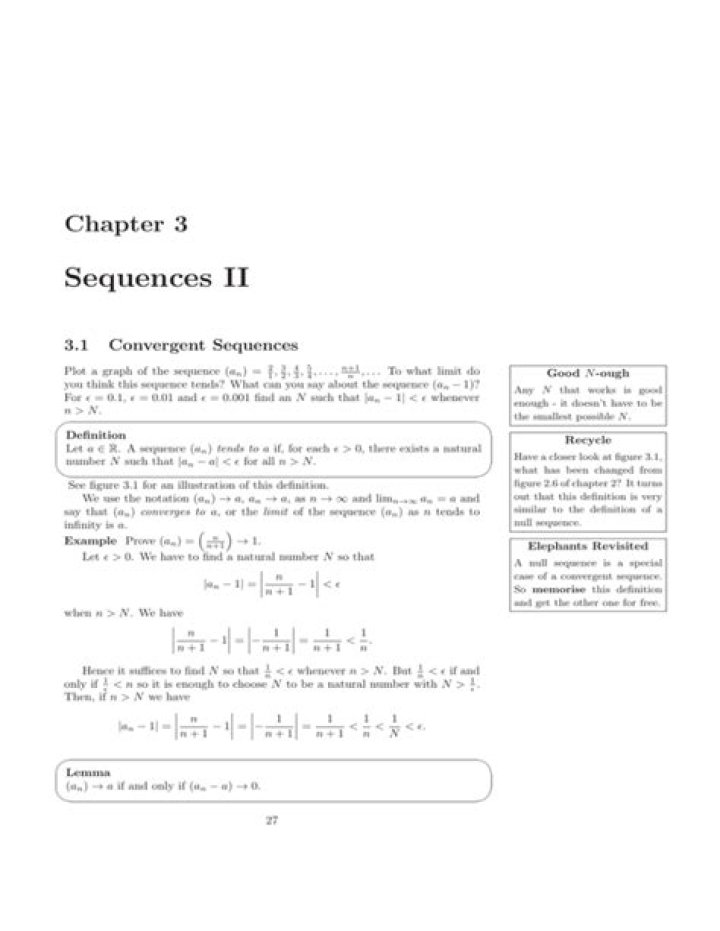
I can see that the limit is 0, but I don't know how to prove convergence. From the definition of convergence, for $\varepsilon > 0$ There exists a natural number N such that for all $n \geq N$, $|1/3^n-0| < \varepsilon$. So how do I prove $1/3^n < \varepsilon$?
$\endgroup$ 34 Answers
$\begingroup$Consider the serie $S=\sum\limits _{i=1}^{\infty} \frac{1}{3^{i}}$. By ratio test,we have to $\lim\limits_{i \rightarrow \infty} \frac{a_{i+1}}{a_{i}}=\frac{1}{3} <1$. Hence, $S$ converges. Therefore, $\lim_{i\rightarrow \infty} a_{i}=0$.
$\endgroup$ 2 $\begingroup$Let $1 < r = 1 + s \implies s \ge 0$
Using the binomial theorem, $r^n = (1+s)^n = 1 + ns + \frac{n(n-1)}2s^2 > 1 + ns > ns$
Taking the reciprocal.
$\frac1{r^n} = \frac1{(1+s)^n} < \frac{1}{1+ns} < \frac1{ns}$
To show convergence (to $0$), we need to find $N $ s.t. $\forall \epsilon > 0$, if $n>N$ then
$|\frac{1}{r^n}| < |\frac1{ns}| < \epsilon $
Which is satisfied for $N = \frac{1}{s\epsilon}$.
If we let $r = 3$, we have proved your sequence converges to $0$
$\endgroup$ $\begingroup$Statement: For a given $\epsilon >0\space \exists$ a $N\in \mathbb{N}$ such that $N\epsilon >1$
Proof: Suppose not. Then for all $N\in \mathbb{N}$, $N\epsilon \leq 1$, then $N\leq 1/\epsilon \Rightarrow N< ([1/\epsilon]+1)=N_0$ (Here $[x]$ is the maximum integer which is less than or equals to $x$.), but by our assumption the inequality holds for every $N\in \mathbb{N}$, then does not exists any $N_0$ i.e. is a contradiction.
Now you can easily show that $1/3^n < \epsilon$ for any $\epsilon >0$ as $n\to\infty$.
$\endgroup$ $\begingroup$here note the use of Bernouli's inequality.
$\dfrac{1}{3}= \dfrac{1}{1+2}\Rightarrow \dfrac{1}{3^n}= \dfrac{1}{(1+2)^n}$
Since $2> -1$, we can use the inequality, $(1+a)^n\geq 1+na\Rightarrow \dfrac{1}{(1+a)^n}\leq \dfrac{1}{1+na}\hspace{10pt}\forall a>-1$
Thus $\dfrac{1}{(1+2)^n}\leq \dfrac{1}{1+2n}< \dfrac{1}{2n}$
There's a very interesting and useful theorem on convergence of a sequence.
Let $(x_n)$ be a real sequence and $x\in \mathbb{R}$. Let $(a_n)$ be a sequence of positive real numbers with $\lim(a_n)= 0$ and if for some constant $C> 0$ and some $m\in\mathbb{N}$ we have $|x_n-x|< Ca_n\hspace{10pt}\forall n\geq m$ then we conclude that $\lim(x_n)= x$
Thus we had, $\dfrac{1}{3^n}< \dfrac{1}{2n}\Rightarrow \left|\dfrac{1}{3^n}-0\right|< \dfrac{1}{2}\cdot\dfrac{1}{n}\hspace{10pt}\forall n\geq 1$
And since $\lim \dfrac{1}{n}= 0$, and $C= \dfrac{1}{2}> 0$ and $m=1$, thus from the above theorem we conclude that $\lim\dfrac{1}{3^n}= 0$
$\endgroup$