Show that $\ln (x) \leq x-1 $
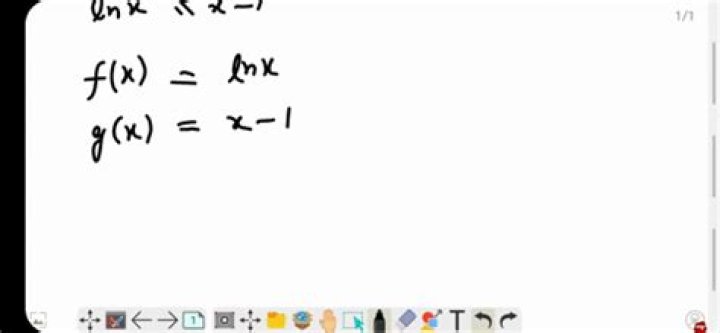
Show that $\ln (x) \leq x-1 $
I'm not really sure how to show this, it's obvious if we draw a graph of it but that won't suffice here. Could we somehow use the fact that $e^x$ is the inverse? I mean, if $e^{x-1} \geq x$ then would the statement be proved?
$\endgroup$ 36 Answers
$\begingroup$Yes, one can use $$\tag1e^x\ge 1+x,$$ which holds for all $x\in\mathbb R$ (and can be dubbed the most useful inequality involving the exponential function). This again can be shown in several ways. If you defined $e^x$ as limit $\lim_{n\to\infty}\left(1+\frac xn\right)^n$, then $(1)$ follows from Bernoullis inequality: $(1+t)^n>1+nt$ if $t>-1$ and $n>0$.
To show that $\ln(x)\le x-1$ for all $x>0$, just substitute $\ln x$ for $x$ in $(1)$.
$\endgroup$ 2 $\begingroup$Define for $\;x>0\;$
$$f(x)=\ln x-x+1\implies f'(x)=\frac1x-1=0\iff x=1$$
and since $\;f''(x)=-\dfrac1{x^2}<0\quad \forall x>0\;$ , we get a maximal point.
But also
$$\lim_{x\to 0+}f(x)=-\infty=\lim_{x\to\infty}f(x)$$
Thus, the above is a global maximal point and
$$\forall\,x>0\;,\;\;\;f(x)\le f(1)=0$$
$\endgroup$ 1 $\begingroup$$y=x-1$ is the equation of the tangent to the ln curve at $(1,0)$ and the function is concave, hence its graph is under the tangent.
$\endgroup$ $\begingroup$There are at least two possible methods, the first is by studying the functions' variation (see Timbuc's answer above) and the second is by Integration: $$\forall x>0,\qquad \frac 1x \leq 1 \iff \int_1^x\frac 1x\; \mathrm dx \leq \int_1^x 1\; \mathrm dx \iff \left[\ln x\right]_1^x \leq \left[x\right]_1^x \\ \iff \ln x - \ln 1 \leq x -1 \iff \boxed {\ln x \leq x -1}.$$Note: I started from $\frac 1x \leq 1$ because it is the derivative of $\ln x \leq x -1$.
$\endgroup$ 2 $\begingroup$Denote $f(x)=\log{x}-x+1$. We have $f'(x)=\frac{1}{x}-1$.
For $0\lt x\leq 1$ we have $f'(x)\geq 0$ so $f$ is increasing from $-\infty$ to $0$
For $x\gt 1$ we have $f'(x)\lt 0$ so $f$ is decreasing from $0$ to $-\infty$
And we have proven $f(x)\leq 0$ Q.E.D
$\endgroup$ $\begingroup$You may want to read the following note by E. R. Love:The Mathematical Gazette Vol. 64, No. 427 (Mar., 1980), pp. 55-57
$\endgroup$