Shortest proof for 'hairy ball' theorem
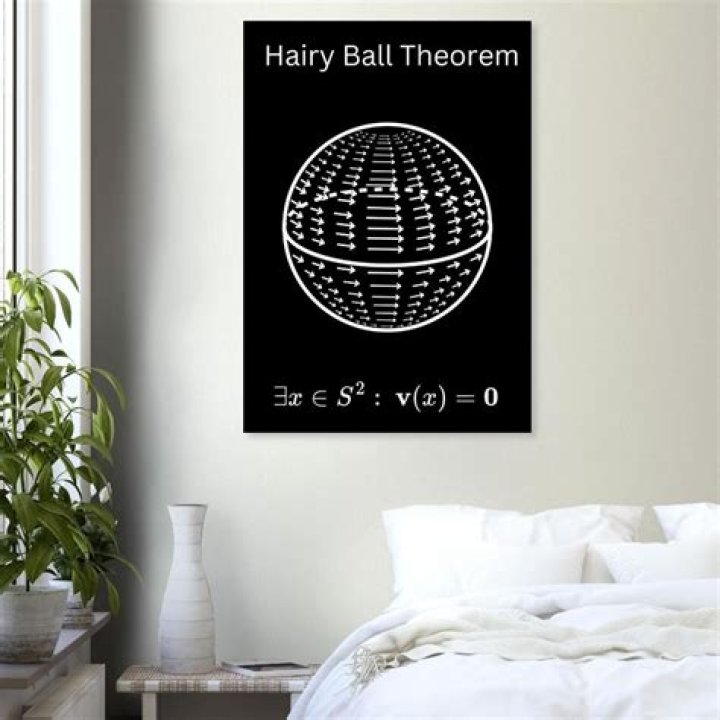
I want to make a project at differential geometry about the Hairy Ball theorem and its applications. I was thinking of including a proof of the theorem in the project. Using the Poincare-Hopf Theorem seems easy enough, but I was thinking that this proves the desired result using a stronger theorem (just like proving Liouville's Theorem in complex analysis using Picard's theorem).
$\endgroup$ 1Is there a simple proof of the fact that there is no continuous non-zero vector field on the even dimensional sphere? It is good enough if the proof works only for $S^2$, because that is the case I will be focusing on in the applications.
3 Answers
$\begingroup$The simplest I can remember off the top of my head is this:
Assume there is such a vector field. Let $v_x$ denote the vector at the point $x$. Now, define the homotopy $H: S^2\times [0, 1] \rightarrow S^2$ by the following: $H(x, t)$ is the point $t\pi$ radians away from $x$ along the great circle defined by $v_x$. This gives a homotopy between the identity and the antipodal map on $S^2$, which is impossible, since the antipodal map has degree $-1$. Hence there can be no such vector field.
$\endgroup$ 2 $\begingroup$There is an elegant and self-contained proof by Milnor: Analytic proofs of the "hairy ball theorem", American Math. Monthly, 85 (1978), 521-524. The paper is reprinted in his collected works and can be downloaded for pay here:
$\endgroup$ 6 $\begingroup$The proof can be found on this site:
$\endgroup$ 1