Second order differential equation initial value problem
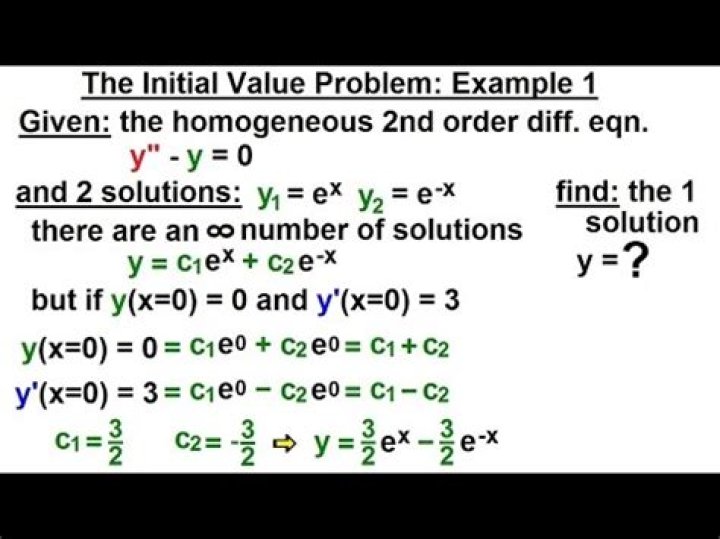
I generally understand problems of finding general solutions, but have been struggling on the following initial value problem: The differential equation $ \frac{d^2 x}{dt^2} +3 \frac{dx}{dt} +2x = 0$ has the general solution $x(t)=C_1 e^{-t} +C_2 e^{-2t}$
If given the information: when $t=0$, $x(0)=1$, and $x'(0)=1$ we can find $C_1$ and $C_2$ by solving the following equations:
$x(0)= C_1 e^{-0} +C_2 e^ {-2(0)}$, or $ x(0)=C_1 (1) +C_2 (1) = 1$
$x'(0)= C_1 (-1) e^{-0} +C_2 (-2) e^{-0}$ or $x'(0)= -C_1 - 2 C_2 = 1$
But how? Perhaps I am misinterpreting the variables $C_1$ and $C_2$
Further: find the solution given the constraints $y'=10y$, $y(0)=0.001$
$\endgroup$ 21 Answer
$\begingroup$with $$C_1+C_2=1$$ and $$-C_1-2-C_2=1$$ adding both we get $$-C_2=2$$ or $$C_2=-2$$ and $$C_1=3$$ for your second equation you will get the solution $$y(x)=Ce^{10x}$$ and $$y(0)=C=\frac{1}{1000}$$
$\endgroup$