Run a tracert continually for period of time
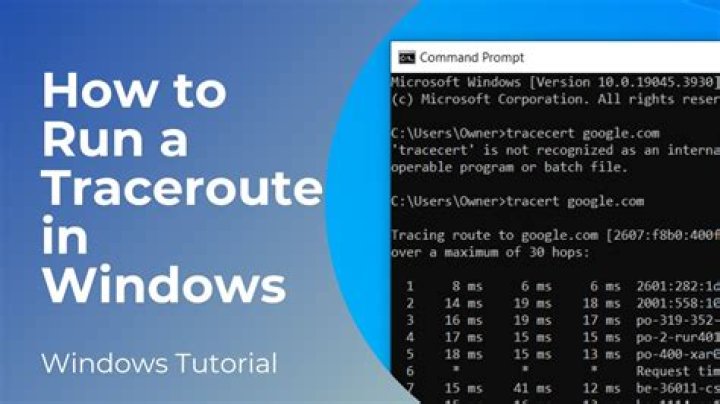
I have a site where network speed and specific network related activities become very slow. I want to run a tracert from one of the PC's onsite to, say, a file server or print server located at our head office and see if and where the dropouts/latency issues are. Is there a way I can tracert between 2 devices constantly back and forth for a specific amount of time to see where the issues are?
52 Answers
A quick solution would be to use a self-calling batch script which displays the date and time before doing a tracert
For example
 @echo off
echo Doing tracert at %date%, %time% >> pinger.txt
tracert 8.8.8.8 >> pinger.txt
pinger.bat
This would keep a batch window open which continuously repeats displaying the date and time and doing a tracert, writing everything to a log file (pinger.txt) until the window is closed.
The resulting log will appear like so:
Doing tracert at 2019-03-14, 2:02:11.87
Tracing route to google-public-dns-a.google.com [8.8.8.8]
over a maximum of 30 hops: 1 2 ms 5 ms 8 ms x.x.x.x 2 18 ms 17 ms 17 ms x.x.x.1 3 17 ms 19 ms 19 ms rc1st-tge0-8-0-0-1.vc.x.net [64.59.149.181] 4 24 ms 25 ms 23 ms rc2wt-be50-1.wa.x.net [66.163.70.106] 5 21 ms 27 ms 23 ms x.14.x.90 6 * * * Request timed out. 7 21 ms 23 ms 21 ms x.125.253.x 8 21 ms 51 ms 19 ms 209.x.254.69 9 23 ms 27 ms 19 ms google-public-dns-a.google.com [8.8.8.8]
Trace complete.
Doing tracert at 2019-03-14, 2:02:58.44
Tracing route to google-public-dns-a.google.com [8.8.8.8]
over a maximum of 30 hops: 1 4 ms 4 ms 2 ms x.x.x.x 2 17 ms 15 ms 15 ms x.x.x.x 3 16 ms 21 ms 21 ms rc1st-x-8-0-0-1.vc.x.net [64.59.149.181] 4 20 ms 21 ms 23 ms rc2wt-x-1.wa.x.net [66.163.70.106] 5 22 ms 21 ms 21 ms 72.x.242.90 6 * * * Request timed out. 7 22 ms 19 ms 23 ms x.125.253.66 8 21 ms 25 ms 27 ms 209.85.x.69 9 24 ms 25 ms 19 ms google-public-dns-a.google.com [8.8.8.8]
Note: IP addresses have been censored with 'x's for anonymity.
Sources:
Date/Time Display & Write to Log File
Some of the smartest people researching latency/slowness problems on the Internet are the people who've collaborated to identify and fix bufferbloat. Along the way they created a tool called Flent, and a specific Flent test called Realtime Response Under Load (RRUL), that's great for discovering bufferbloat-related latency problems between any two hosts you control on the Internet or any IP network.
I'd recommend you look into running a Flent RRUL test between the two sites in question.