"Rigorous" definition of Cartesian coordinates
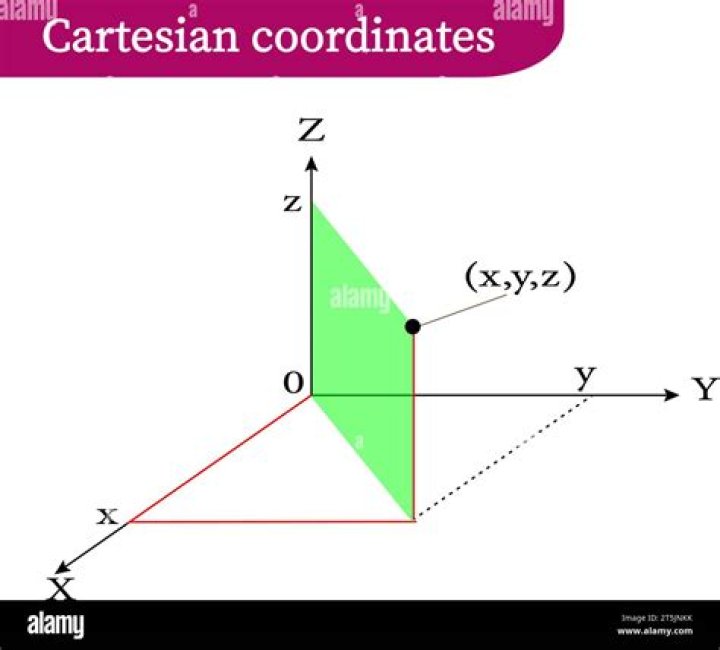
I, like most, first learned about Cartesian coordinates very early on in my educational career, and so the most instructional way to think about them was that you place down some perpendicular lines and measure the perpendicular distance from each line to get your coordinates; in other words, an operational definition. Now that I'm much farther along in my education, though, I wonder whether or not there's another, more "rigorous" way to define Cartesian coordinates, perhaps using the idea of a coordinate system as a mapping? Or is my question a bit pointless, since we already have the operational definition?
$\endgroup$ 65 Answers
$\begingroup$One formalization of the intuitive notion of a coordinate system is the rigorous notion of a chart on a manifold. This formalizes the notion of a local coordinate system, where our coordinates aren't globally well-defined and only make sense in some particular region; this is the notion of coordinates one needs to use in physics to understand, for example, relativity. If you want to get perpendicular lines and so forth into the game your manifold needs to be a Riemannian manifold.
$\endgroup$ $\begingroup$I'm also surprised not to find any definition of Cartesian coordinate, so let's suggest this (personal and most simple) definition:
$\endgroup$ $\begingroup$A cartesian coordinate on a Euclidean space E (finite dimensional $\mathbb{R}$ vector space, with a scalar product) is a "global chart" = Euclidean space isomorphism = isometry from $E$ to $\mathbb{R}^n$
If you're thinking about manifolds, it's most useful to think about how you can write the metric for the coordinate system: if it can be written as g_ab = diag(+/- 1, +/-1 , ...) then you're in Cartesians. That immediately give you the line element, in the positive case being the familiar Pythagorean addition of ds^2 = dx^2 + dy^2 + ... . The negative case is important in pseudo-Euclidian manifolds.
$\endgroup$ $\begingroup$Based on my experience superimposing Cartesian coordinate systems on a multitude of practical problems, these are the key elements in the process:
1) Units. The coordinate numerics appeal to physical distances, so you must choose what physical distance your coordinate unit represents (and use the same units in all dimensions).
2) Origin. You have to pin down the location for your origin.
3) Axes directions. You have to choose axis reference directions.
a) For a 2D system, you have to choose the + x-axis based on some reference beacon or marker. The +y-axis will be 90 deg. CCW from the + x-axis.
b) For a 3D system, you have to choose 2 out of the 3 axis directions. The 3rd axis will depend on choice of the first two. To follow convention, the 3 axes must be mutually orthogonal, and obey the right-hand rule:
x_dir x y_dir --> z_dirWhere x_dir and y_dir are axis direction vectors [ 1, 0, 0 ] and [0, 1, 0 ] and z_dir is [ 0, 0, 1 ] and "x" is the right-handed 3D vector cross product.
Before you can define a mapping, you must have some kind of reference coordinate system (to express the mapping in).
$\endgroup$ $\begingroup$In most (all ?) French mathematics books, Cartesian frames are defined as follows, e.g. in 'Affine Geometry' (Cagnac, Ramis, Commeau) - [my translation] : "A Cartesian frame is defined in space by a point O (called origin), and by three independant vectors, i, j, k ; that is three non-vanishing vectors, such that their representatives originating in O be carried by the edges of a trihedron."
Similarly, one can refer to a parallelogram in 2D.
Therefore, in France (Descartes country of origin), orthonogonal and orthonormal coordinates are only special cases of "Cartesian coordinates". I am not suggesting that the French education is more right in this matter than the American one. I am only emphasizing the fact that when dealing with this topic, it is worth having this in mind.
An other source for this fact is simply given by as compared to
I imagine that other countries where the French mathematical culture has been influent may also use the same definition for Cartesian coordinates.
$\endgroup$