Representation of Tangent function on unit circle
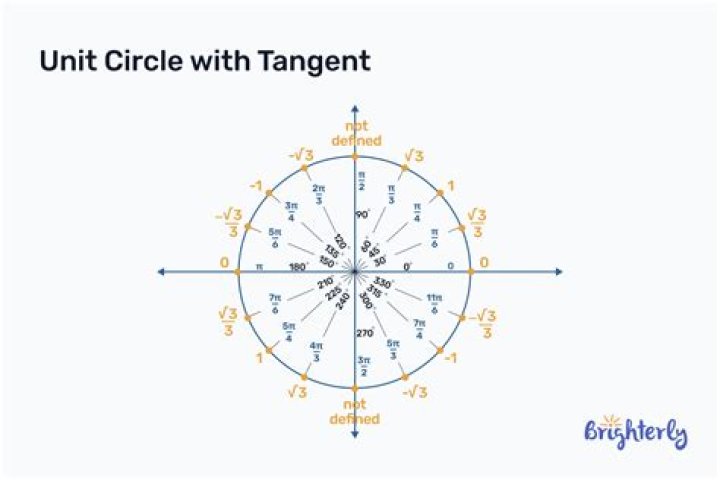
I have found a interesting website in Google. It represents tangent function of a particular angle as the length of a tangent from a point that is subtending the angle.I thought it is really an amazing result. But I can't digest it because I don't know proof.I had tried many times but failed repeatedly.Help me proving this fact
3 Answers
$\begingroup$The two right triangles are similar (the one with the tangent and the one with sine and cosine). Consider the two legs and do the proportion.
P.S. If you prolong the line of the tangent, you obtain the cotangent (same proof above). Also, you see where that line crosses the x and y axis? They’re secant and cosecant!
$\endgroup$ 2 $\begingroup$There are a lot of similar triangles in the picture. Let's call the origin $A$, the point on the unit circle $B$, the point $(\cos \theta, 0)$ C, and the point where the tangent meets the $x$-axis $D$. Now you can note that triangles $ABC$ and $BCD$ are similar (they share two identical angles). Equating ratios of corresponding sides, we have $\frac{BC}{AC} = \frac{DC}{BC} \implies DC = \frac{\sin^2 \theta}{\cos \theta}$. By Pythagoras, $BD$, which is also the length of the tangent, must be $$\sqrt{DC^2 + BC^2} = \sqrt{\frac{\sin^4 \theta}{\cos^2 \theta} + \sin^2 \theta} = \sin \theta \sqrt{\tan^2 \theta + 1} = \sin \theta \sec \theta = \tan \theta$$
$\endgroup$ $\begingroup$I found this picture from the MIT "Calculus with Applications" course very helpful:
Source: click here
Let's call the origin of the unit circle $F$.
$\sin\theta=\frac{\text{opposite}}{\text{hypotenuse}}=\frac{BD}{BF}=\frac{\sin\theta}{1}$ in $\triangle BDF$
$\cos\theta=\frac{\text{adjacent}}{\text{hypotenuse}}=\frac{BE}{BF}=\frac{\cos\theta}{1}$ in $\triangle BEF$
$\tan\theta=\frac{\text{opposite}}{\text{adjacent}}=\frac{BC}{BF}=\frac{\tan\theta}{1}$ in $\triangle BCF$
$\csc\theta=\frac{\text{hypotenuse}}{\text{opposite}}=\frac{AF}{BF}=\frac{\csc\theta}{1}$ in $\triangle ABF$
$\sec\theta=\frac{\text{hypotenuse}}{\text{adjacent}}=\frac{CF}{BF}=\frac{\sec\theta}{1}$ in $\triangle BCF$
$\cot\theta=\frac{\text{adjacent}}{\text{opposite}}=\frac{AB}{BF}=\frac{\cot\theta}{1}$ in $\triangle ABF$
$\endgroup$