Relationship between sine and cosine in a circle [closed]
My teacher asked us this question today: What is the relationship between sine and cosine in a circle? No one had any answer to this. Can someone enlighten me here?
$\endgroup$ 47 Answers
$\begingroup$Here is something interesting: This graphic is sort of the relationship that you want. I think that this is the simplest you can get with this question if this is what you mean by relationships between sine, cosine, and a circle.
Notice how the brown stick moves in a circle, and the gold bars, which correspond to sine and cosine, move up and down and side to side just like a wave-like formation!
$\endgroup$ 1 $\begingroup$It is impossible to know what your teacher might have been fishing for, but one key relation is that $$ \sin(x) = \cos(\pi/2 - x). $$ This is the same as $\cos(x - \pi/2)$ because $\cos$ is an even function.
Another relation between sine and cosine is $$ \sin^2(x) +\cos^2(x) = 1. $$ For more indentities you can see:
$\endgroup$ $\begingroup$$$\sin(x) = \cos\left(x - \frac{\pi}{2}\right)$$
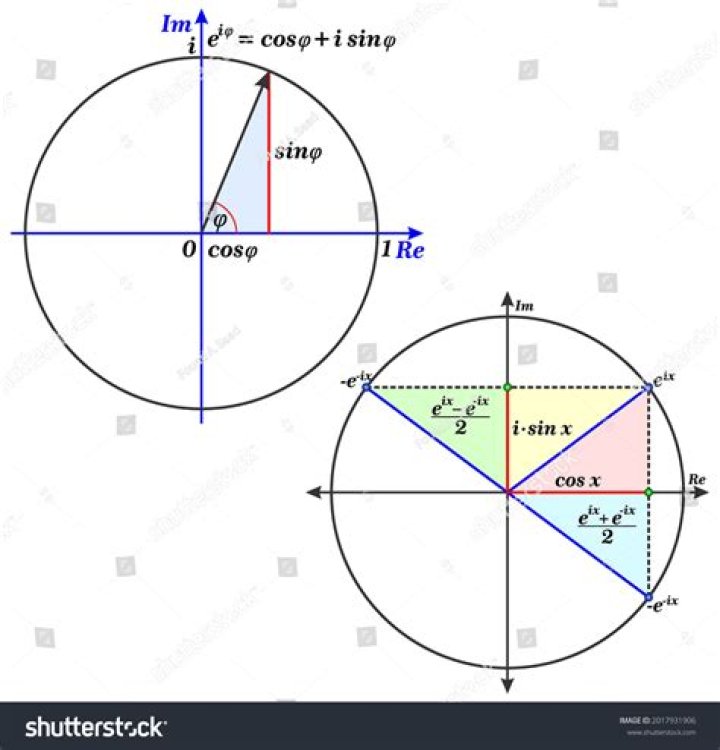
$\endgroup$ $\begingroup$The best description of the relationship between these things is Euler's formula: $$e^{it}=\cos (t)+i\sin (t) $$
$\endgroup$ $\begingroup$i don't know if this what you are after. take a point $(x, y)$ on the unit circle $x^2 + y^2 = 1.$ let $t$ be the signed length of the arc measured from the point $(1,0)$ with the convention that counter clockwise is considered positive.
now we can see $ x = \cos t, y = \sin t.$ that is $cos t$ is the projection of $(x,y)$ onto the $x$-axis. same goes for $\sin t.$
$\endgroup$ $\begingroup$The relationship between $\sin$ and $\cos$ is nicely presented by the following figure:
Other algebraic relationships are just representation of some geometric properties.
$\endgroup$ 1 $\begingroup$The relationship between the sine and the cosine is a quite open-ended question.
- They both oscillate periodically, but the sine lags behind the cosine by a quarter of a full period. That is expressed by $\cos x = \sin\left(x+\dfrac\pi2\right)$ or $\cos\theta^\circ=\sin\left(\theta^\circ+90^\circ\right)$. A quarter of a full period is either $\pi/2$ radians or $90^\circ$.
- The cosine of one angle is the sine of the complementary angle. The two acute angles in a triangle are complementary to each other, so the cosine of either of those angles is the sine of the other.
- The value of the cosine at any point is proportional to the rate at which the sine is changing at that point. If, but only if, radian measure is used, the constant of proportionality is $1$. Similarly the rate at which the cosine is changing is proportional to the sine, and if radians are used, the the constant of proportionality is $-1$.
- The sum of the squares of the sine and cosine is always $1$.
- The sine and cosine functions are at right angles to each other in the inner product relevant to Fourier series.
Doubtless one can say far more than the above.
Is it possible that the teacher asked the question within some particular context that made the meaning clear in a way that rules out all but one of the above bullet points?
$\endgroup$