Relation between Diagonals in a pentagon
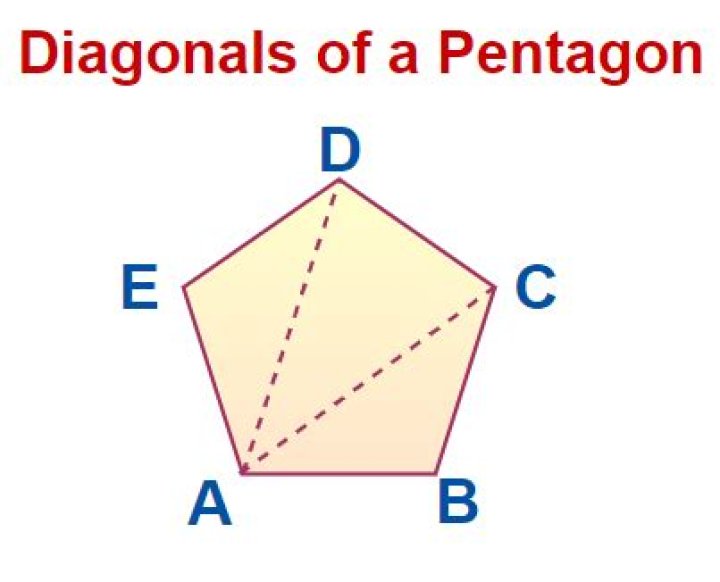
i do need another pair of eyes to look at this stupid question:
Take a regular pentagon and draw diagonals from each vertex/point. By doing that, you create another pentagon in the middle of the old one. Regarding the n-Pentagon with sides $s_n$ and diagonals $d_n$, show the following formula:
$d_{n+1} = d_n - s_n$
$s_{n+1} = d_n - 2d_{n+1} = 2s_n - d_n$
As mentioned, im not to interested in any kind of full solutions, since this is pretty basic stuff, i just in the need for someone to make sense of this question and explain to me, what i have to do here.
$\endgroup$ 11 Answer
$\begingroup$Given a regular pentagon $ABCDE$, draw diagonals $AC$ and $BE$ which intersect at $F$. $BCDF$ is a parallelogram because each diagonal is parallel to the side it does not meet at the vertices, thus $AF=BF=$(diagonal minus side).
Next draw all five diagonals of the pentagon. Let $F$ be the intersection of $AC$ and $BE$ as above; $G$ be the intersection of $AD$ and $BE$; $H$ be the intersection of $BD$ and $CE$. You should be able to prove triangles $AFG$ and $HFG$ congruent by $ASA$, thus the diagonals of the inner pentagon equal (diagonal minus side) of the outer one.