Relation between chords length and radius of circle
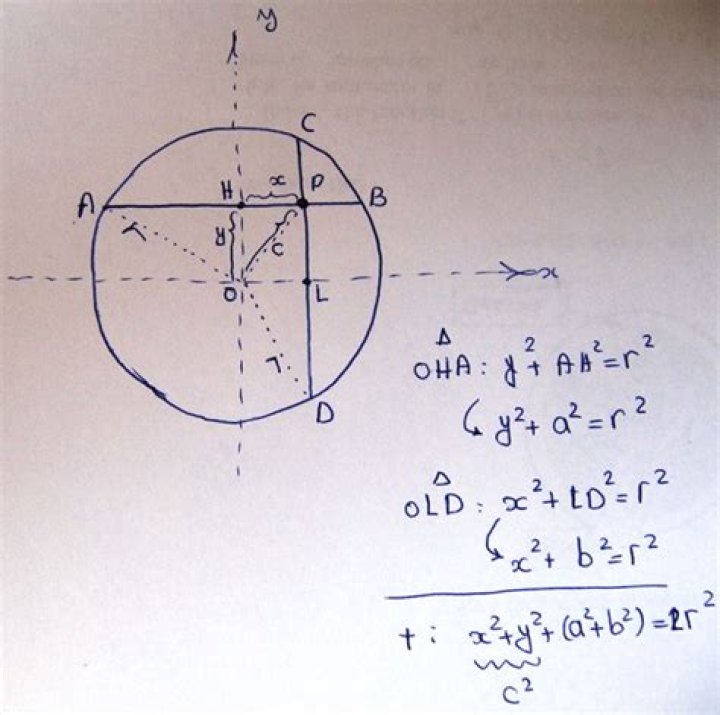
Two chords of a circle, of lengths $2a$ and $2b$ are mutually perpendicular. If the distance of the point at which the chords intersect,from the centre of the circle is $c$($c<$radius of the circle),then find out the radius of the circle in terms of $a,b$ and $c$.Show some short-cut to do it quickly
$\endgroup$ 04 Answers
$\begingroup$Another similar approach may be arisen as following: ${}{}{}{}{}{}{}{}{}{}{}{}{}{}{}$
Let $a'$, $b'$ be the lengths of the perpendiculars from $M$ to the chord of length $2a$, resp. $2b$. Then $$c^2=a'^2+b'^2=(r^2-a^2)+(r^2-b^2)\ ,$$ from which we obtain $$r=\sqrt{a^2+b^2+c^2\over2}\ .$$
$\endgroup$ $\begingroup$Let $P$ be the point where the two chords (and a diameter) meet. Let $h$ (and $k$) be the distance from $P$ to the midpoint of the $2a$ chord (respectively, the $2b$ chord); that is, say $P$ divides the chord into sub-segments of length $a+h$ and $a-h$ (respectively, $b+k$ and $b-k$). Note that $P$ divides a diameter into sub-segments of length $r+c$ and $r-c$ (where $r$ is the radius of the circle); note also that $c$ is the hypotenuse of a right triangle with legs $h$ and $k$: so, $c^2 = h^2 + k^2$.
The Power of a Point principle says that every chord through a particular point of a circle is divided into sub-segments such that the product of the lengths of those sub-segments is a constant (the so-called "power" of the point in question). Thus,
$$(a+h)(a-h) = (b+k)(b-k) = (r+c)(r-c)$$
More succinctly,
$$a^2 - h^2 \;\;=\;\; b^2 - k^2 \;\;=\;\; r^2 - c^2$$
With an eye towards combining an $h^2$ with a $k^2$, I'll add the left-hand and "middle-hand" sides together; their sum is necessarily twice the right-hand side:
$$\begin{align} ( a^2 - h^2 ) + ( b^2 - k^2 ) &= 2 (r^2 - c^2) \\ \implies a^2 + b^2 - ( h^2 + k^2 ) &= 2 r^2 - 2 c^2 \\ \implies a^2 + b^2 - c^2 &= 2 r^2 - 2 c^2 \\ \implies a^2 + b^2 + c^2 &= 2 r^2 \end{align}$$
$\endgroup$ $\begingroup$Draw a circle through c. Let's suppose the chords are parallel to the x and y axis, and that the points a and b lie on some large circle, and the lines $x=a$ and $y=b$ cross at $A, B$
We then have the equation that $A^2+B^2=C^2$ for the crossing, which gives these lines, and thence $A^2 + b^2 = a^2 + B^2 = R^2$, which leads to the equation $a^2+b^2+c^2 = 2R^2$.
Answer: $R^2 = (a^2+b^2+c^2)/2$
$\endgroup$ 3