reflexive relation on a set
We know relation $R$ from set $A$ to set $B$ is subset of $A\times B$, then why we define reflexive relation on single set $A$(say) e.g, we have a set $A=\{1,2,3,4,5\}$ and $B=\{1,2,3,4,5,6,7\}$ and $R=\{(1,2),(1,1),(2,2),(3,3),(4,4),(5,5),(1,7)\}$ is $R$ reflexive relation? can we define reflexive relation from a set A to B where B is super set of A?
$\endgroup$ 31 Answer
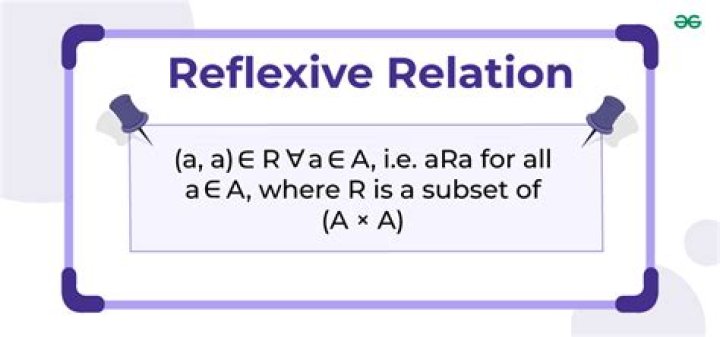
$\begingroup$A relation is reflexive on a set when every element in the set is related to itself.
A relation of $A\to B$ cannot be reflexive for your example because no element in $A$ is in $B$.
$A=\{1,2,3\}, B=\{4,5\}, R \subseteq A\times B \implies R\subseteq\{(1,4), (1,5), (2,4), (2,5), (3,4), (3,5)\}$
In general, if two the sets from which a relation is constructed are not identical, then there will exist a member of one set that cannot be related to itself, because it is not in the other set.
More over, the $R$ you gave is not a subset of $A\times B$. The first member of the paired elements of such a subset must come from $A$ and the second from $B$; that's the definition of the Cartesian product.
$$A\times B = \{(a,b) \mid a\in A, b\in B\} $$
What you gave is a subset of the Cartesian square of the union of the two sets.
$$\{(1,2),(1,1),(2,2),(3,3),(4,4)\} \subset (A\cup B)\times(A\cup B) = \{(p,q)\mid p\in A\cup B, q\in A\cup B\}$$
$\endgroup$