Reasoning that $ \sin2x=2 \sin x \cos x$
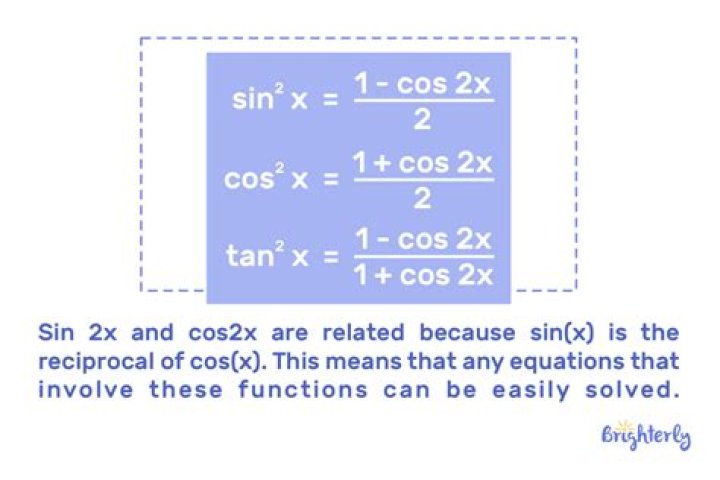
In mathcounts teacher told us to use the formula $ \sin2x=2 \sin x \cos x$. What's the math behind this formula that made it true? Can someone explain?
$\endgroup$8 Answers
$\begingroup$$$\color{red}{\sin 2x}=\color{blue}{2\sin x}\cos x$$
$$\sin(2x)=\mathrm{Im}(e^{2ix})=\mathrm{Im}(e^{ix}e^{ix})=\mathrm{Im}((\cos x+i\sin x)(\cos x+i\sin x))=2\sin x\cos x$$
$\endgroup$ 5 $\begingroup$Assuming that you already know the sum of angles formula, this is pretty easy to get:
$\sin(x + y) = \sin(x)\cos(y) + \cos(x)\sin(y)$, so
$\sin(2x) = \sin(x + x) = \sin(x)\cos(x) + \cos(x)\sin(x) = 2\sin(x)\cos(x)$.
Edit: If you don't want to take the sum of angles formula for sines as a given, this page on Wikipedia can explain it better than I can, especially since it has a diagram.
$\endgroup$ 2 $\begingroup$A rotation matrix is clearly a linear transformation, so by rotating the elementary basis vectors, a two-dimensional rotation matrix for angle $x$ is \begin{align} \begin{bmatrix} \cos(x) & -\sin(x) \\ \sin(x) & \cos(x) \end{bmatrix}. \end{align}
Squaring this matrix is equivalent to applying the rotation twice, so \begin{align} \begin{bmatrix} \cos(2x) & -\sin(2x) \\ \sin(2x) & \cos(2x) \end{bmatrix} &= \begin{bmatrix} \cos^2(x) - \sin^2(x) & -2\sin(x)\cos(x) \\ 2\sin(x)\cos(x) & \cos^2(x) - \sin^2(x) \end{bmatrix}, \end{align} which implies that \begin{align} \cos(2x) &= \cos^2(x) - \sin^2(x) \\ \sin(2x) &= 2\sin(x)\cos(x). \end{align}
Using rotation matrices with different angles gives some of the double-angle (or triple-angle, etc.) identities.
$\endgroup$ $\begingroup$Geometrically, the area of an isosceles triangle with apex $2\alpha$ and leg length $1$ can be computed with one of the legs as base, then the height is $\sin 2\alpha$. So th earea is $\frac12\sin 2\alpha$.
Alternatively, the base has length $2\sin \alpha$ and the corresponding height is $\cos \alpha$, thus the area is $\frac12\cdot2\sin\alpha\cos\alpha$.
Equating both, you get $\sin2\alpha=2\sin\alpha\cos\alpha$.
$\endgroup$ 1 $\begingroup$Hint: Find the area of the rectangular ABCD from the triangle AFD and normal way:
All of those weird trigonometric identities make sense if you express them as exponentials.
$$\sin 2x = 2\sin x \cos x. $$
Using $e^{xi} = \cos x + i\sin x $ and expressing $\cos$ and $\sin$ through this...
\begin{align} &\frac{e^{2xi} - e^{-2xi}}{2i} = 2 \frac{e^{xi} - e^{-xi}}{2i} \frac{e^{xi} + e^{-xi}}{2},\\ &\frac{e^{2xi} - e^{-2xi}}{2i} = \frac{(e^{xi} - e^{-xi})(e^{xi} + e^{-xi})}{2i},\\ &\frac{e^{2xi} - e^{-2xi}}{2i} = \frac{e^{2xi} - e^{-2xi}}{2i}. \end{align}
Of course, the geometric interpetation makes more sense here.
$\endgroup$ $\begingroup$Let's start with the power series definitions: $$\sin x=\sum_{n=0}^\infty (-1)^n \frac{x^{2n+1}}{(2n+1)!}=x-\frac{x^3}{3!}+\frac{x^5}{5!} -+ \dots, $$ $$\cos x=\sum_{n=0}^\infty (-1)^n \frac{x^{2n}}{(2n)!}=1-\frac{x^2}{2!}+\frac{x^4}{4!}-+ \dots. $$ If you expand the product $$\sin x \cos x= \left( x-\frac{x^3}{3!}+\frac{x^5}{5!} -+ \dots \right) \left( 1-\frac{x^2}{2!}+\frac{x^4}{4!}-+ \dots \right), $$ and collect terms, you will find that only odd powers of $x$ appear, and the coefficient of $x^{2n+1}$ is $$(-1)^n \left(\frac{1}{(2n+1)!0!}+\frac{1}{(2n-1)! 2!}+ \dots +\frac{1}{1!(2n)!} \right).$$ You can prove (using induction for example) that the last expression equals $$(-1)^n \frac{2^{2n}}{(2n+1)!}=(-1)^n \frac{1}{2} \frac{2^{2n+1}}{(2n+1)!}.$$ Thus we have $$\sin x \cos x=\frac{1}{2} \sum_{n=0}^\infty (-1)^n \frac{(2x)^{2n+1}}{(2n+1)!}, $$ which is precisely $\frac{1}{2} \sin 2x$.
$\endgroup$