Quadratic vertex form - negative $h$ means it's on the right side of the graph?
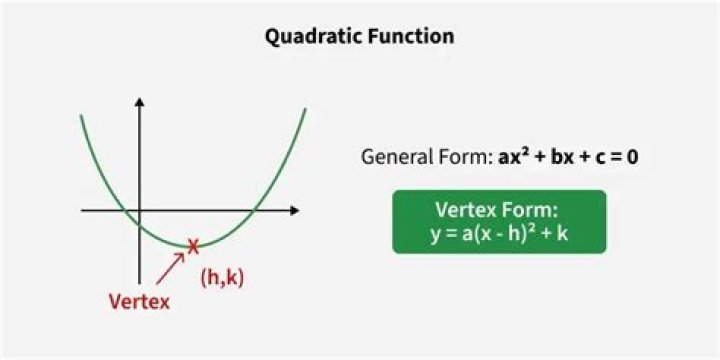
When putting a quadratic equation in vertex form, I am having difficulty understanding why $h$ is negative when the location of the parabola goes to the right... why is this?
For example, if I have... $y = -2(x-2)^2+9$
I understand that
- $a$ is -2, which means that it is a down-facing parabola
- $k$ is 9, which means that its vertex is positive and above the x-axis
I do not understand that since $k$ is negative, that means the location of the parabola is on the right side of the graph? Shouldn't it be on the left side, since it is negative? Also, when using a Flash quadratic graph displaying tool, it produces these results:
When I specify $h$ to be positive, it comes out to be negative in the quadratic equation. What's up with this?
Thanks
$\endgroup$5 Answers
$\begingroup$Look at a simpler problem. You know what the graph of $y=x$ looks like, yes? Now think about the graph of $y=x-7$. If you can understand why that's shifted to the right by $7$, and not to the left, you're well on the way to answering your parabola question.
$\endgroup$ 0 $\begingroup$Look at $(x-2)^2$, and calculate this for, say, $x=2+1/3$ and $x=2-1/3$. In either case you get $1/9$. Now calculate at $x=2+4$ and at $x=2-4$. In either case you get $16$.
Calculate $(x-2)^2$ at $x=2+t$ and at $x=2-t$. If you do the algebra carefully, you will get an answer of $t^2$ in each case. So going $t$ to the right of $x=2$, and going $t$ to the left, gives the same $y$-value.
Geometrically, that means that the curve is symmetrical about the vertical line with equation $x=2$, that this line is the axis of symmetry of the parabola.
Basically the same thing would happen with $(x-5)^2$. The line $x=5$ would be an axis of symmetry.
Now repeat the calculation with say $(x+3)^2$. If you put $x=-3+t$, and $x=-3-t$, in each case you will get $t^2$. The line $x=-3$ is the axis of symmetry.
$\endgroup$ $\begingroup$In addition to the other answers, it may help to think of the vertex-form equation in a slightly different format, moving $k$ to the same side as $y$: $$y-k=a(x-h)^2$$ This is like $y=x^2$, but stretched in some fashion (I'm intentionally vague here) to get $y=ax^2$, then shifted by $\langle h,k\rangle$, moving the vertex from $(0,0)$ to $(h,k)$ to get $y-k=a(x-h)^2$.
That is, changing $x\mapsto x-h$ and $y\mapsto y-k$ in the equation moves the graph right $h$ and up $k$.
$\endgroup$ $\begingroup$The parameter $h$ is the extremal point of the quadratic. The extremum happens when $x=h$, when the function $(x-h)^2$ is minimized (or $-(x-h)^2$ maximized). So the reason for the minus sign is because $x=h$ is equivalent to $x-h=0$.
$\endgroup$ $\begingroup$(X-2) means the parabola is shifted to the right (X-(-2)) or (X+2) means it shifts to the left.
Just remember that when it comes to vertex form and parabola transformations a negative h means shift right and positive h left.
We anumberd to the number lgraphbitself itself having negative integers on left and positive on right and I can see why this throws people off.
Best way to fix is think of it as a reverse of that.
$\endgroup$