Proving equivalence relations
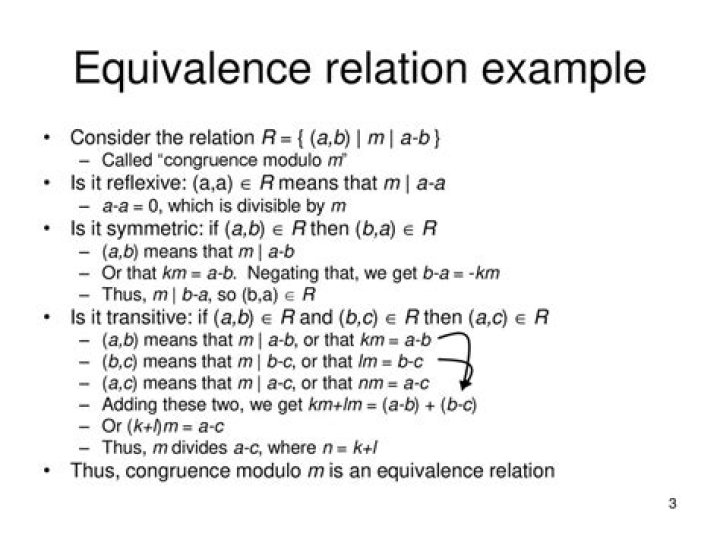
I just started my abstract algebra class and I am struggling with the concept of equivalence relations. I know that in order to prove equivalence relations, I have to prove the reflexive, symmetric, and transitive properties. However, I don't know how to go about starting the actual proof or solution. I have these examples and any help would be appreciated.
I have to show which of the following are equivalence relations on the set of real numbers and, if they are not, why.
- $a\sim b$ iff $|a|=|b|$
- $a\sim b$ iff $a\leq b$
- $a\sim b$ iff $|a-b| \leq 1$
Thank you for any help!
$\endgroup$2 Answers
$\begingroup$As you say, we check whether or not they're reflexive, symmetric, and transitive.
We define $a \sim b$ if $|a|=|b|$ for $a,b \in \mathbb{R}$. So we check:
- Reflexive: Is $a \sim a$ for all $a \in \mathbb{R}$? Yes, because $|a|=|a|$.
- Symmetric: If $a,b \in \mathbb{R}$ and $a \sim b$, does it follow that $b \sim a$? Yes, because $|a|=|b|$ implies $|b|=|a|$.
- Transitive: If $a,b,c \in \mathbb{R}$ and $a \sim b$ and $b \sim c$, does it follow that $a \sim c$? Yes, because $|a|=|b|$ and $|b|=|c|$ implies $|a|=|c|$.
Hence this is an equivalence relation.
We define $a \sim b$ if $a \leq b$ for $a,b \in \mathbb{R}$. So we check:
- Reflexive: Is $a \sim a$ for all $a \in \mathbb{R}$? Yes, because $a \leq a$.
- Symmetric: If $a,b \in \mathbb{R}$ and $a \sim b$, does it follow that $b \sim a$? Not in general, because e.g. $2 \leq 3$ but $3 \not\leq 2$.
- Transitive: If $a,b,c \in \mathbb{R}$ and $a \sim b$ and $b \sim c$, does it follow that $a \sim c$? Yes, because $a \leq b$ and $b \leq c$ implies $a \leq c$.
We conclude that $\leq$ is not an equivalence relation (since it's not symmetric).
And so on.
$\endgroup$ 2 $\begingroup$Reflexive:- (a,a)belongs to 'R' all 'a' belongs to'A' Symmetric:- (a,b) belongs to 'R' for all 'a' belongs to 'A' Transitive:- if (a,b) belongs to 'R' (b,c) belongs to 'R' then (c,a) belongs to 'R' for all (a,b,c) belongs to 'A' Antisymmetric :- 'a' relation 'b' and 'b' relation 'a' IF a=b for all (a,b) belongs total 'A'
$\endgroup$