Proof that linear polynomial has exactly one root
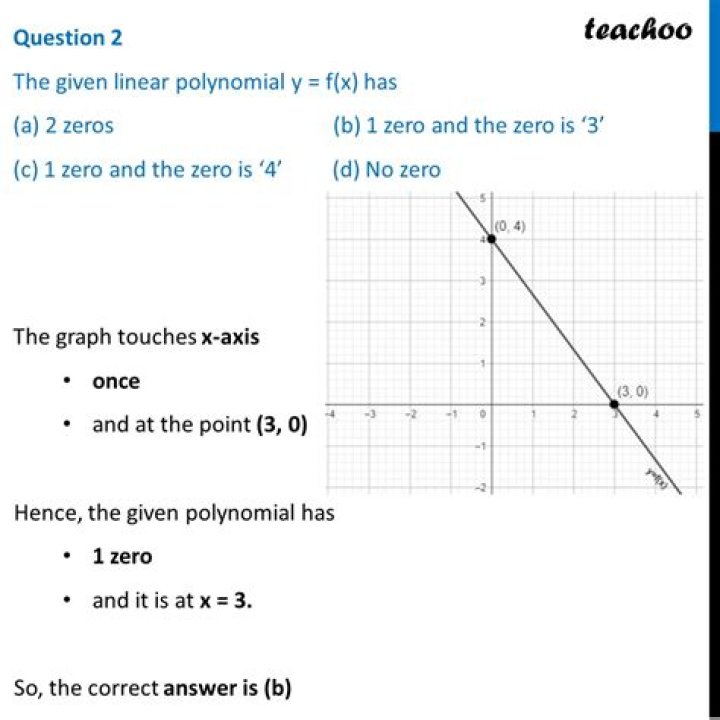
How can one prove that all linear polynomials have exactly one root? This is geometrically intuitive (just rotate a line around the x axis) however I'm not sure how to formally prove this.
$\endgroup$ 43 Answers
$\begingroup$A linear polynomial is of the form $f(t) = at+b$ for some coefficients $a$, and $b$, $a \neq 0$ over a field $F$. A root of a polynomial $f$ is a value $t$ satisfying $f(t) = 0$. It is clear that
$$f(t) = 0 \Rightarrow t = -\frac{b}{a}. $$
Therefore, we have precisely one root, $t = -b/a$.
$\endgroup$ 2 $\begingroup$Let $p(x) = a x + b$ be a linear polynomial where $a$ is non-zero.
Suppose that $x_1$ and $x_2$ are solutions to $p$. Then
$$a x_1 + b = 0 = a x_2 + b$$
Subtracting $b$ from both sides we have,
$$a x_1 = a x_2$$
And dividing both sides by non-zero $a$,
$$x_1 = x_2$$
This shows that roots are always equal. Note if $a$ is zero, there will be infinite or no roots, and this logic does not follow.
$\endgroup$ $\begingroup$I'd do it like this - suppose $ax_1+b=ax_2+b$ then $$a(x_1-x_2)=0$$ and this means $a=0$ or $x_1-x_2=0$
This last step is possible because for real numbers $xy=0$ implies $x=0$ or $y=0$. There are other mathematical contexts where this is true. But it is not always true, and sometimes we have non-trivial divisors of zero. For example $2\times 3 \equiv 0 \bmod 6$.
This way of writing may look the same as others, but avoids division and gives an equation which remains true in a lot of contexts. It identifies the precise property which allows the next step to be taken (no non-trivial divisors of zero).
$\endgroup$