Proof of the divisibility rule of 11.
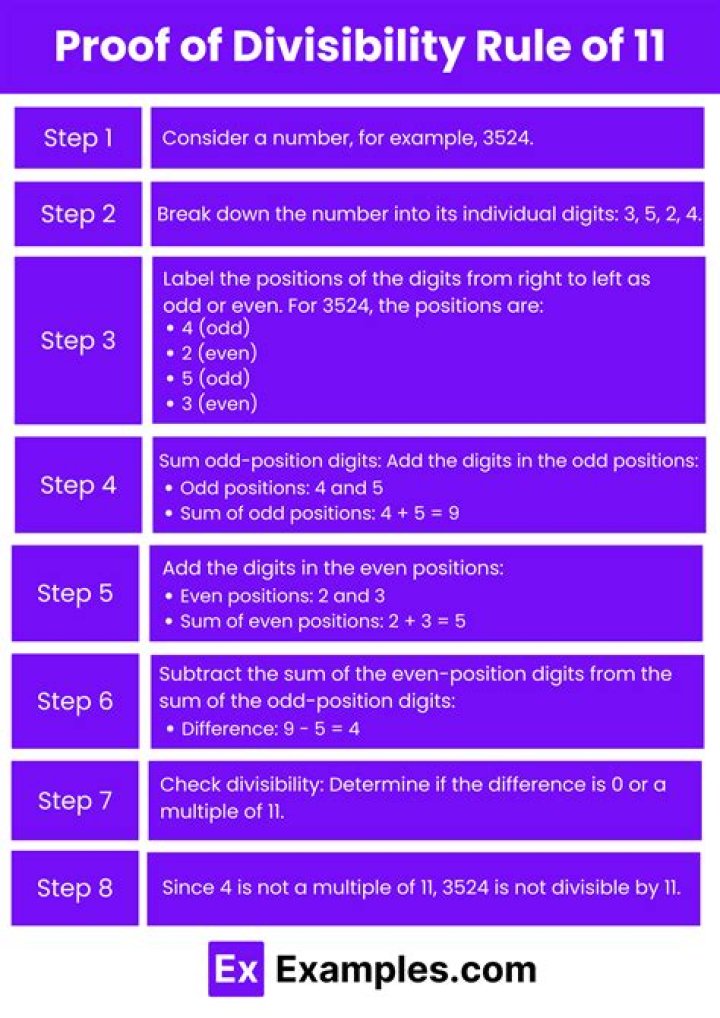
We know,
A number is divisible by $11$ if the difference of the sum of the digits in the odd places and the sum of the digits in the even places is divisible by $11$.
For example, Let's consider $814$:
Sum of the digits in the odd places $= 8 + 4 = 12$
Sum of the digits in the even place $= 1$
Difference between the two sums $= 12 - 1 = 11$
$11$ is divisible by $11$.
Hence, $814$ is divisible by $11$.
What is the proof of this?
$\endgroup$ 52 Answers
$\begingroup$If you know modular arithmetic, here is a hint:
Write any $n \in \mathbb{N}$ in base $10$ so let $n=\sum_{i=0}^{k}(10)^i c_i$. Now use the fact that $10\equiv -1\pmod{11}$. Then clearly
$\sum_{i=0}^{k}(10)^i c_i \equiv \sum_{i=0}^{k}(-1)^i c_i \quad (\mod 11). $
Of course, the last sum is the sum you mentioned.
$\endgroup$ 2 $\begingroup$Note that $$ 1,100,10000,...$$ are all congruent to $1$ in $\pmod {11}$
Also $$ 10, 1000,100000,...$$ are all congruent to $-1 $ in $\pmod {11}$
$$814 = 8(100)+1(10)+4(1) \equiv 8(1)+1(-1)+4(1)\equiv 0 \pmod {11}$$You can take it from there and finish the proof.
$\endgroup$ 2