Proof of symmetry for trigonometric functions
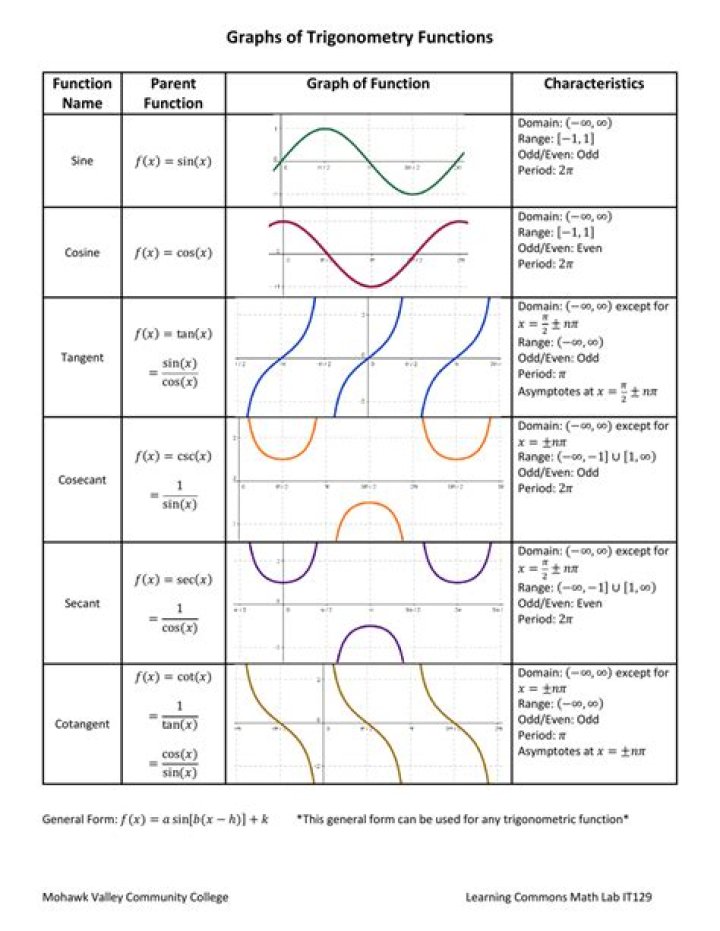
How can I algebraically prove this trigonometric symmetry for sin?
$\sin(-x) = -\sin(x)$
$\endgroup$ 72 Answers
$\begingroup$You can go from the definition of $sin(x) = \sum^\infty_{n=0}\frac{(-1)^nx^{2n+1}}{(2n+1)!}$
From there, factor $-x$ into $(-1)x$ and use $(xy)^a = x^ay^a$
Notice since $n$ is an integer you can say that $(-1)^{2n+1} = (-1)^{1}= -1$
$\endgroup$ 2 $\begingroup$If you can use complex numbers and Euler's formula, try this algebraic argument:
Let $z= e^{ix} = \cos x+i\,\sin x$. Then $$ e^{-ix} = \frac1z = \frac{\bar z}{z\bar z} = \frac{\cos x - i \sin x}{\cos^2 + \sin^2x} = \cos x - i \sin x $$
On the other hand, $$ e^{-ix} = \cos(-x)+i\,\sin(-x) $$
Comparing real and imaginary parts we get $$ \cos(-x) = \cos(x) \qquad \sin(-x) = -\sin(x) $$
$\endgroup$ 4