Proof of divergence theorem
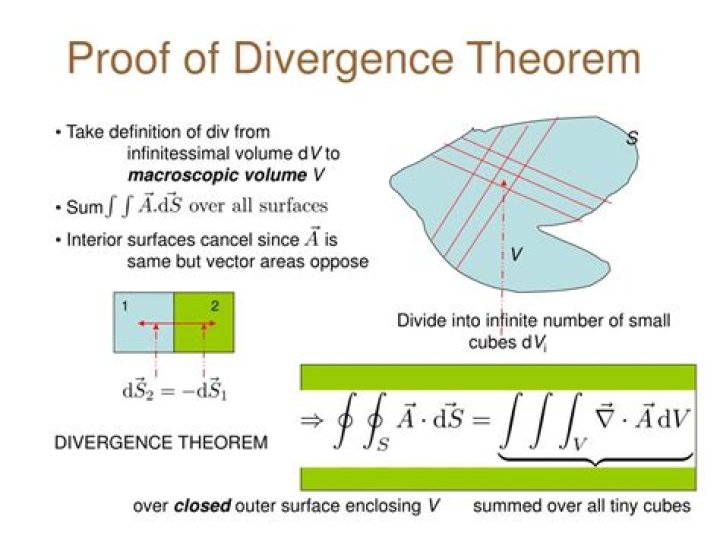
I am trying to proof the classical Gauss's divergence theorem given by,
For a bounded domain $D\in \mathbb{R}^N$ with a smooth boundary $\partial D$. For the function $F=(F_1,F_2,...,F_N)$ it is given by
$\int_{D}div(F)dx=\int_{\partial D}F\cdot v dS_x$, where $S$ is the surface of $D$ and $v$ denotes the surface normal vector.
I have proven this for $N=1$ by
$\int_{a}^bf'(x)dx=1\cdot f(b)+(-1)\cdot f(a)$ for any $(a,b)\in \mathbb{R}$, i.e. $F(x)=f(x)$ and $div(F)=f'(x)$.
But for general $N\in \mathbb{N}$, any hints?
$\endgroup$ 1 Reset to default