Proof of archimedean property
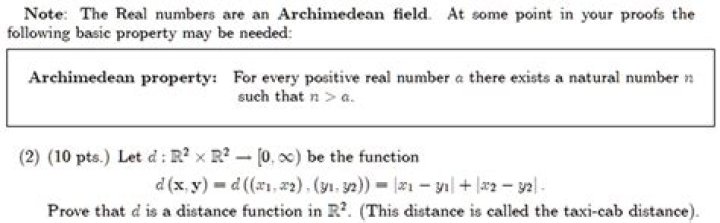
I am trying to self-study Baby Rudin (and it's proving quite challenging to me)
Could someone clarify where the underlined part comes from?
Text:
(a) If $x \in R, y \in R,$ and $x > 0$, then there is a positive integer $n$ such that $nx > y$.
Proof (a) Let $A$ be the set of all $nx$, where $n$ runs through the positive integers. If (a) were false, then $y$ would be an upper bound of $A$. But then $A$ has a least upper bound in $\mathbb{R}$. Put $\alpha = \sup A$. Since $x > 0$, $\alpha - x < \alpha$, and $\alpha - x$ is not an upper bound of $A$. $\underline{\text{Hence $\alpha - x < mx$ for some positive integer $m$}}$. But then $\alpha < (m+1)x \in A$, which is impossible, since $\alpha$ is an upper bound of $A$.
Thanks in advance
$\endgroup$3 Answers
$\begingroup$Since $\alpha -x$ is not an upper bound of $A$, there must be an element in $A$, call it $mx$, bigger than $\alpha-x$, namely $\alpha -x < mx$. It is the logical negation of the property of being an upper bound for a subset of $\mathbb{R}$.
$\endgroup$ 2 $\begingroup$We know $\alpha$ - $x$ is not an upper bound of $A$. i.e. there exists some element of A greater than $\alpha - x$. So let this element, greater than $\alpha - x$ be written as $mx$ for some m, an element of the postive integers. So then $\alpha -x \lt mx$.
$\endgroup$ $\begingroup$The following seems far simpler to me, but there must be something wrong if Rudin doesn't include it. Maybe the $\lceil$ceiling$\rceil$ function is not defined yet? Thoughts?
Statement:
If $x,y \in \mathbb{R}$ and $x >0$, then there is a positive integer $n$ such that $nx>y$.
Proof:
Given $x,y>0$, let $n=\lceil{\frac{y+1}{x}}\rceil$. Then,
\begin{align*} nx&= \lceil {\frac{y+1}{x}} \rceil \cdot x \\ &\ge y+1\\ &>y. \end{align*}$$\tag*{$\square$}$$
$\endgroup$ 1