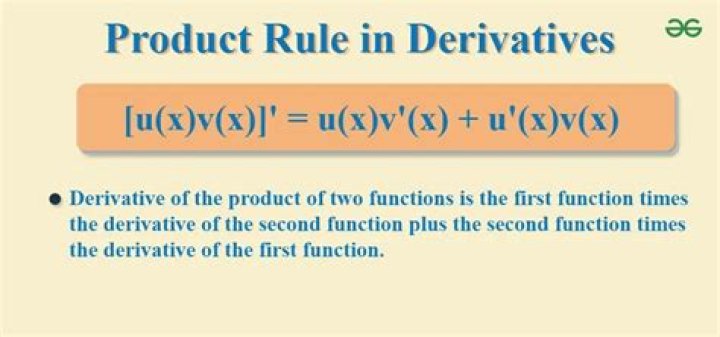
Product rule for the derivative of a dot product.
I can't find the reason for this simplification, I understand that the dot product of a vector with itself would give the magnitude of that squared, so that explains the v squared. What I don't understand is where did the 2 under the "m" come from.
(The bold v's are vectors.)
$$m\int \frac{d\mathbf{v}}{dt} \cdot \mathbf{v} dt = \frac{m}{2}\int \frac{d}{dt}(\mathbf{v}^2)dt$$
Thanks.
Maybe the book's just wrong and that 2 should't be there...
$\endgroup$ 82 Answers
$\begingroup$The derivative of the dot product is given by the rule $$\frac{d}{dt}\Bigl( \mathbf{r}(t)\cdot \mathbf{s}(t)\Bigr) = \mathbf{r}(t)\cdot \frac{d\mathbf{s}}{dt} + \frac{d\mathbf{r}}{dt}\cdot \mathbf{s}(t).$$
Therefore, $$\begin{align*} \frac{d}{dt} \lVert \mathbf{r}(t)\rVert^2 &= \frac{d}{dt}\left( \mathbf{r}(t)\cdot \mathbf{r}(t)\right)\\ &= 2\mathbf{r}(t)\cdot \frac{d\mathbf{r}}{dt}. \end{align*}$$ Dividing by through by $2$, we get $$\frac{d\mathbf{v}}{dt}\cdot \mathbf{v}(t) = \frac{1}{2}\frac{d}{dt}\lVert \mathbf{v}\rVert^2.$$
$\endgroup$ 2 $\begingroup$If two $n$-dimensional vectors $\mathbf u$ and $\mathbf v$ are functions of time, the derivative of their dot product is given by $$\frac{\mathrm d}{\mathrm dt}(\mathbf u\cdot\mathbf v) = \mathbf u\cdot\frac{\mathrm d\mathbf v}{\mathrm dt} + \mathbf v\cdot\frac{\mathrm d\mathbf u}{\mathrm dt}$$ This is analogous to (and indeed, is easily derived from) the product rule for scalars, $\frac{\mathrm d}{\mathrm dt}(ab) = a\frac{\mathrm db}{\mathrm dt} + b\frac{\mathrm da}{\mathrm dt}$.
Therefore, $$\frac{\mathrm d}{\mathrm dt} \lVert\mathbf v\rVert^2 = \frac{\mathrm d}{\mathrm dt}(\mathbf v\cdot\mathbf v) = \mathbf v\cdot\frac{\mathrm d\mathbf v}{\mathrm dt} + \mathbf v\cdot\frac{\mathrm d\mathbf v}{\mathrm dt} = 2\mathbf v\cdot\frac{\mathrm d\mathbf v}{\mathrm dt}$$ just like $\frac{\mathrm d}{\mathrm dt} a^2 = 2a\frac{\mathrm da}{\mathrm dt}$. Halve that, and you have the result you need.
$\endgroup$ 1