Probability of at least 2 occurring from 4 independent events
Say you have a group of horse races, Race A,B,C,D
What is the chance of picking at least 2 (minimum of 2 winners) winners from these 4 horse races...
The chance of winning A is :1 in 4.2 (0.238)
The chance of winning B is :1 in 2.58 (0.388)
The chance of winning C is :1 in 5 (0.200)
The chance of winning D is :1 in 1.9 or (0.526)
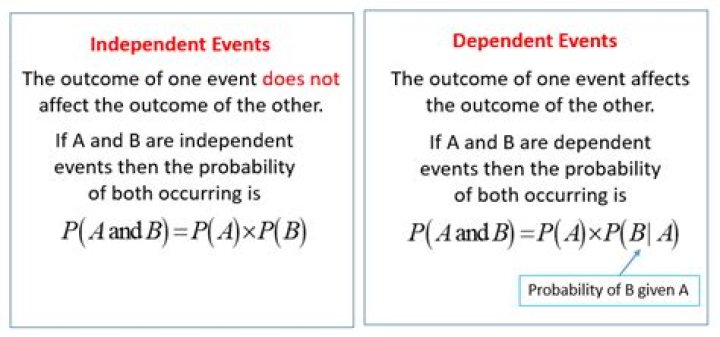
(all races are independent)
I have tried to work this out using the decimal value: (A * B)+ (A * C)+ (A * D) +(B * C) + (B * D) + (C * D)= 0.652 or 1 in 1.52
I have tried to use excel but when i play around in excel with the odds/probability values i can exceed 1, which means my equation is wrong
Ie changing all the values to 1 in 2 would give 0.25 = (A * B) *6 which would give 1.5 which is clearly incorrect
Thanks
EDIT: Apologies Jmoravitz it should have read "at least 2 winners"
EDIT 2: Many Thanks for the input to my question, after using the help provided i got a answer of 0.415 to 3sf or roughly 1 in 2.41 for atleast 2 winners
$\endgroup$ 23 Answers
$\begingroup$Hint -
Your are doing it wrong. Its not the method of finding atleast 2 winners.
As you have 4 persons so better to find probability of none winner or 1 winner and subtract both probabilities from 1.
No winner -
$A(Lose) \times B(Lose) \times C(Lose) \times D(Lose)$
One winner -
$A(Win) \times B(Lose) \times C(Lose) \times D(Lose)+A(Lose) \times B(Win) \times C(Lose) \times D(Lose)+A(Lose) \times B(Lose) \times C(Win) \times D(Lose)+A(Lose) \times B(Lose) \times C(Lose) \times D(Win)$
$\endgroup$ 3 $\begingroup$Hint: As JMoravitz already said you have to loose some races. And you should use the converse probability.
$P("\texttt{Winning at least two races}")=1-P("\texttt{Winning at most 1 race}")$
For instance, the probability of winning exactly one race is
$P(A)\cdot P(\overline B )\cdot P(\overline C)\cdot P(\overline D)+P(B)\cdot P(\overline A )\cdot P(\overline C)\cdot P(\overline D)+P(C)\cdot P(\overline B )\cdot P(\overline A)\cdot P(\overline D)+P(D)\cdot P(\overline B )\cdot P(\overline C)\cdot P(\overline A)$
$\endgroup$ $\begingroup$Let $W_1,W_2,W_3,W_4$ be the event that $A,B,C,D$ win their race, respectively. Then by the Principle of Inclusion and Exclusion:
$$\def\Pr{\mathop{\sf P}}\begin{align}\Pr\left(\bigcup\limits_{1\leq j< k\leq 4} W_jW_k\right)~&=~{\sum\limits_{1\leq j<k\leq 4} \Pr(W_jWk)-\sum\limits_{1\leq i<j<k\leq 4}\Pr(W_iW_jW_k)+\Pr(W_1W_2W_3W_4)}\\[1ex] &=~{{\sum\limits_{1\leq j<k\leq 4} \Pr(W_j)\Pr(Wk)}-{\sum\limits_{1\leq i<j<k\leq 4}\Pr(W_i)\Pr(W_j)\Pr(W_k)}+{\Pr(W_1)\Pr(W_2)\Pr(W_3)\Pr(W_4)}}\\[1ex] &=~ {{\Pr(W_1)\Pr(W_2)}+{\Pr(W_1)\Pr(W_3)}+{\Pr(W_1)\Pr(W_4)}+{\Pr(W_2)\Pr(W_3)}+{\Pr(W_2)\Pr(W_4)}+{\Pr(W_3)\Pr(W_4)}-{\Pr(W_1)\Pr(W_2)\Pr(W_3)}-{\Pr(W_1)\Pr(W_2)\Pr(W_4)}-{\Pr(W_2)\Pr(W_3)\Pr(W_4)}+{\Pr(W_1)\Pr(W_2)\Pr(W_3)\Pr(W_4)} } \\[1ex] &=~ {{\Pr(W_1)\big(\Pr(W_2)+\Pr(W_3)+\Pr(W_4)\big)}+{\Pr(W_2)\big(\Pr(W_3)+\Pr(W_4)\big)}-{\Pr(W_1)\Pr(W_2)\big(\Pr(W_3)+\Pr(W_4)\big)}+{\Pr(W_3)\Pr(W_4)\big(\Pr(W_1)\Pr(W_2)-\Pr(W_1)-\Pr(W_2)+1\big)} }\end{align}$$
OR if you prefer:
$$\bbox[ghostwhite,1ex, border:dotted 0.1pt green]{\begin{align}\Pr(AB\cup AC\cup AD\cup BC\cup BD\cup CD) &={{\Pr(A)\big(\Pr(B)+\Pr(C)+\Pr(D)\big)}+{\Pr(B)\big(\Pr(C)+\Pr(D)\big)}-{\Pr(A)\Pr(B)\big(\Pr(C)+\Pr(D)-\Pr(C)\Pr(D)\big)}+{\Pr(C)\Pr(D)\big(1-\Pr(A)-\Pr(B)\big)}}\end{align}}$$
$\endgroup$