Primitive 8th roots of unity in Z17
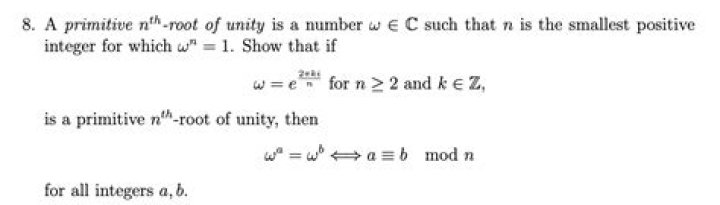
If $\omega=\frac{\sqrt{2}}{2}+i \frac{\sqrt{2}}{2}$, then $\omega$ is an 8th root of unity. And I know $\omega,\omega^3,\omega^5$,and $\omega^7$ are furthermore primitive 8th roots of unity in $\mathbb{C}$. But what happens when we change $\mathbb{C}$ to $\mathbb{Z}/17\mathbb{Z}$ (integers mod 17)? How can I find the primitive 8th roots of unity in $\mathbb{Z}/17\mathbb{Z}$?
$\endgroup$ 12 Answers
$\begingroup$Note that $2^4\equiv -1$ (mod 17), hence $2^8\equiv 1$ (mod 17). So $2$ is a primitive 8th root of unity. The other primitive 8th roots of unity mod 17 are $2^3=8$, $2^5\equiv 15$, and $2^7\equiv 9$.
In general, $\mathbb{Z}/p\mathbb{Z}$ for a prime $p$ contains all the $n$th roots of unity precisely when $n$ divides $p-1$.
$\endgroup$ $\begingroup$The multiplicative group of $\mathbb{Z}/17\mathbb{Z}$ is cyclic of order $16$.
Therefore, there are $\phi(8)=4$ elements of order $8$. (Just like in $\mathbb C^\times !$)
In the context of groups, a primitive 8th root of unity is the same as an element of order $8$.
$\endgroup$