Polar to cartesian form of $ r = \sin(2\theta)$
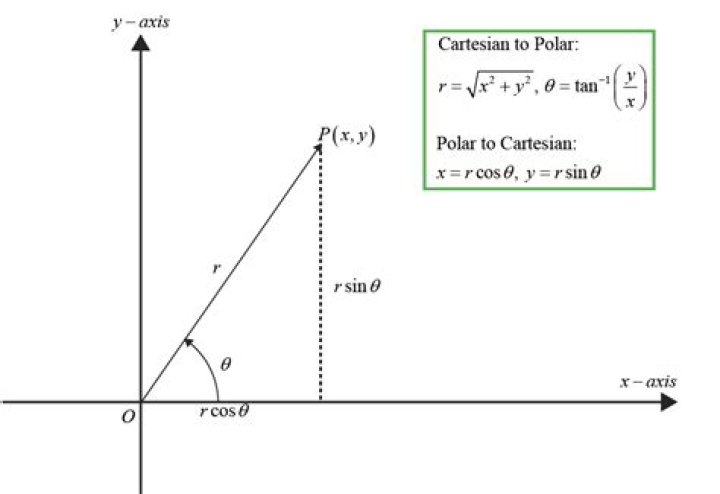
As title describes, I was wondering how I would put this into Cartesian form, from polar.
All I have is $ r = \sin(2\theta)$.
I'm not really sure what to do, I've been trying to find similar problems on the internet to no avail (at least with an explanation), nor can I figure it out myself. Any help would be great.
$\endgroup$ 62 Answers
$\begingroup$$r = \sin(2\theta) = 2\sin\theta\cdot \cos\theta \to r^3 = 2(r\sin\theta)(r\cos\theta)$. Then use:
$x = r\cos\theta$, and $y = r\sin\theta$, and $r = \sqrt{x^2 + y^2}$ to finish.
$\endgroup$ 1 $\begingroup$$$r = \sin(2\theta) = 2\sin\theta\cdot \cos\theta$$ $$r^3 = 2(r\sin\theta)(r\cos\theta)$$
$$x = r\cos\theta$$ $$y = r\sin\theta$$
$$r^3 =2xy$$
$$r = (x^2 + y^2)^{\frac 12}$$
$$(x^2+y^2)^{\frac 32} =2xy$$ $$(x^2+y^2)^3=4x^2y^2$$
$\endgroup$ 1