Partial Derivative with Respect to Multiple Variables
If we take a multivariable function such as $w=f(x,y,z)=x^2+y^2+z^2$, I understand that we can take its partial derivative with respect to any one of its arguments, while the others stay unchanged. In this case, we can take the partial derivative with respect to $z$ as $\frac{\partial}{\partial z}f(x,y,z)$. I also understand that we can take its total derivative which is with respect to all of its arguments, which can be expressed as $\frac{dt}{dw}f(x,y,z)$.
My question: how do we represent the derivative with respect to some but not all of a multivariable function's variables? How is this derivative classified? I am tempted to think it is partial but I am not sure since all of the definitions I have seen give it with respect to a single variable. Is it a "partial" total derivative?
$\endgroup$ 31 Answer
$\begingroup$What I think you mean is (for example), something like this $$\frac{\partial}{\partial x}\frac{\partial}{\partial y}w$$
This is usually denoted by $$\frac{\partial^2 w}{\partial x\partial y}$$and is defined by $$\lim_{\delta x\to 0}\lim_{\delta y \to 0}\left(\frac{f(x+\delta x,y+\delta y,z)-f(x+\delta x,y,z)-f(x,y+\delta y,z)+f(x,y,z)}{\delta x\delta y}\right)$$
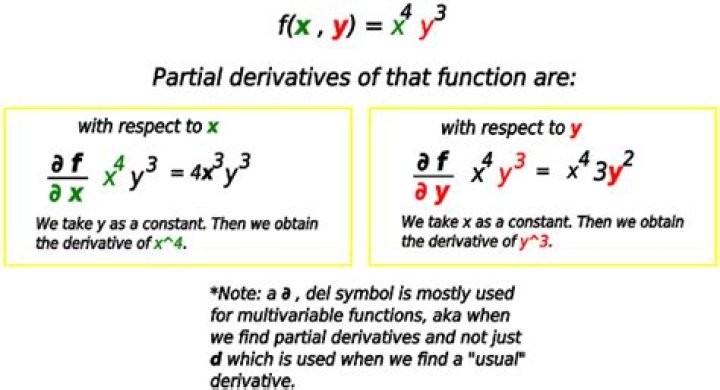
As an example, if we let $f(x,y,z)=x^2y^3$, then $$\frac{\partial^2 f}{\partial x\partial y}=\frac{\partial }{\partial x}\frac{\partial }{\partial y}(x^2y^3)=\frac{\partial }{\partial x}(3x^2y^2)=6xy^2$$
$\endgroup$ 4