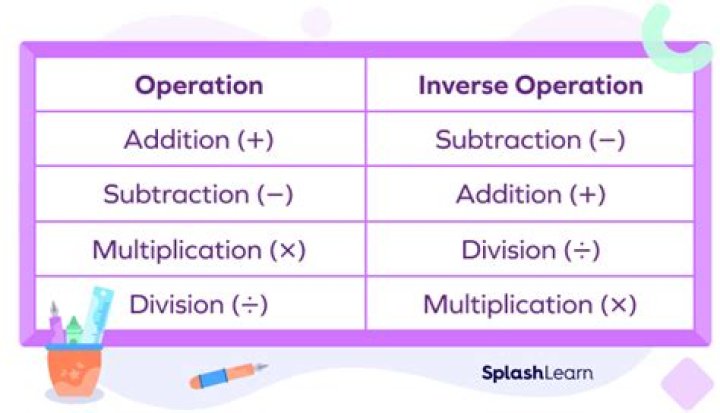
Order of Inverse Operations
so this is a very simple question but I am having a tough time with it.
So it's finals week and I'm studying up for an Algebra 2 final. The only part I am having trouble with is finding the inverse of a function. It doesn't confuse me that I have to basically undo everything that is happening to x (or any variable) but it confuses me what order I have to undo everything in.
Say I have the expression $f(x)= \sqrt{x-3}$. I would first substitute $f(x)$ with y and then switch the x and y so I'd be finding x. After that I'd square x and then add 3 to x to make the equation $y = x^2 + 3$.
But what if I had the expression $f(x)= \sqrt{x-3} + 5$? Would I subtract 5 and then square the x and 5 or would I square x and then add 3 and subtract 5?
Thanks.
$\endgroup$2 Answers
$\begingroup$I think you're on the right track, but maybe a bit muddled in your thought; yes, the way to invert the function $f(x)=\sqrt{x-3}+5$ is to start with $y$, subtract $5$ from it, square that, then add $3$. That is,$$(y-5)^2+3=x.$$
The easiest way to think about this is to consider what such a function is doing; that is, $f(x)$ could be described as:
- Start with $x$. Subtract $3$ from it.
- Take the square root of the result of that.
- Add five to that result.
Symbolically, we could describe this as a composition of functions - that is, if we let$$a(x)=x-3$$$$b(x)=\sqrt{x}$$$$c(x)=x+5$$then we can describe$$f(x)=c(b(a(x))).$$
How do we undo this? Well, we undo each step, in reverse order. That is,
To undo the last step, we subtract $5$ from $y$.
Then, to undo the step before that, we square that value.
Finally, to undo the first step, we add $3$ to the result.
Symbolically, this is to say that$$f^{-1}(y)=a^{-1}(b^{-1}(c^{-1}(y)))$$where$$c^{-1}(x)=x-5$$$$b^{-1}(x)=x^2$$$$a^{-1}(x)=x+3.$$
That is, we invert each of the "component" function, and then we just plug them in in the reverse order. Then, of course this works because we'd have$$f^{-1}(f(x))=a^{-1}(b^{-1}(c^{-1}(c(b(a(x))))))$$but we can cancel the inner $c^{-1}(c(\text{stuff}))$ to just the stuff inside, as $c^{-1}$ undoes $c$ and we keep canceling like that to get that $f^{-1}(f(x))=x$, as desired.
$\endgroup$ 1 $\begingroup$Use the order of operations to track what happens to $x$. In your example, $f(x) = \sqrt{x-3} + 5$, we have (starting with $x$):
subtract $3$
take the (positive) square root
add $5$.
To undo these and solve for $x$, we would undo each, in reverse order. (You noted this much in your question).
subtract $5$
square
add $3$