Number of rectangles to cover a circle
After searching around I found this is similiar to the Gauss Circle but different enough (for me anyway) that it doesn't translate well.
I have a circle, radius of 9 that I need to completely cover with rectangles 4 x 8. What is the minimum number of whole rectangles required. My own calculations concluded it's between 8 and 11. I found this by setting the maximum number of panels equal to (diameter of circle / panel height)x(diameter of circle/panel width) to obtain 10.125 rounded up to 11 I do think I could safely use 10 due to waste. I then found the minimum by setting the number of panels equal to (area of circle/area of panel). This gave me an answer of 7.95, rounded up to 8.
Is there a better way to do this?
$\endgroup$ 13 Answers
$\begingroup$It is possible to cover the circle by $11$ rectangles.
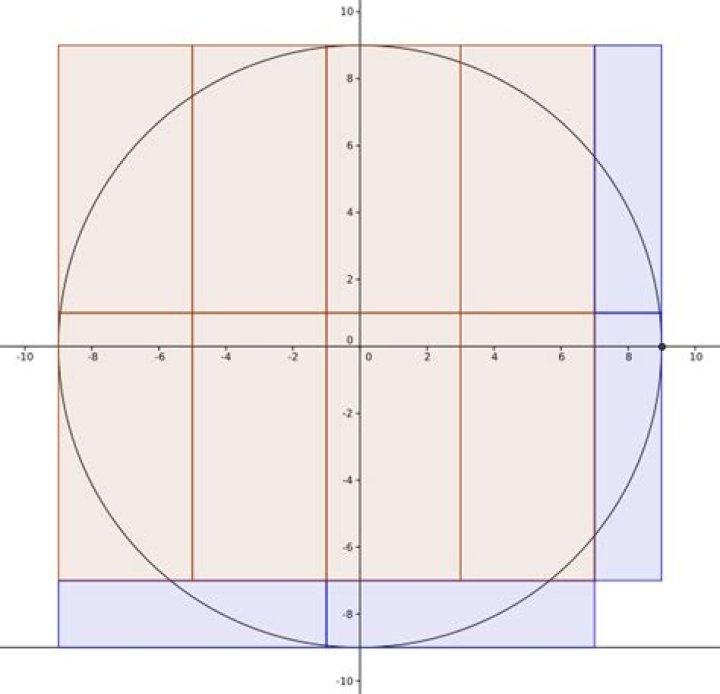
We can construct the $11$ rectangles by following procedure.
- Center the circle of radius $9$ at origin.
- Start covering the circle with rectangle $C_0 = [5,9] \times [-4,4]$ (the red one).
- Rotate $C_0$ with respect to origin for angles $\frac{2k}{7} k \pi $ for $k = 1,\ldots, 6$. This gives us $6$ new rectangles $C_1, C_2, \ldots, C_6$ (the gray ones).
- Making copies of $C_0$, $C_2$ and $C_5$ and shift them inwards for a radial displacement $4$. This give us $3$ rectangles $C'_0$, $C'_2$ and $C'_5$ (the green ones). To make the covering work, one need to shift $C'_2$ and $C'_5$ a little bit tangentially too.
- What's remain on the circle can be covered by the rectangle $[-7,1] \times [-2,2]$ (the blue one).
According to Erich's packing center, the current best known covering of circle by $18$ unit squares has radius $r \approx 2.116$. Since $2.116 \le 2.25 = \frac{9}{4}$, this means there is no known covering of our circle with $9$ rectangles. This leaves us with the question whether we can reduce the number of rectangles from $11$ to $10$.
$\endgroup$ 1 $\begingroup$Neither process is guaranteed to work. In the spirit of the first, you could do (diameter circle/panel height) rounded up times (diameter circle/panel width) rounded up. In your example, this would give $\lceil \frac {18}8\rceil \cdot \lceil \frac {18}4 \rceil = 3 \cdot 5 = 15$. This creates a rectangle that is large enough to cover your circle in both dimensions. In this case the rectangle will be $24 \times 20$ feet, clearly enough. Your second calculation is fine if you are willing to cut up the rectangles, perhaps into very small pieces. If you want to keep the rectangles whole, you can't count on using all the area.
Packing problems are often hard. All you can do is try layouts of the rectangles to find one that covers. I found the below, which uses $12$ rectangles. The dimensions are a factor $1/4$ times yours. There might be a way to do it with fewer rectangles.
I was also unable to cover with fewer than 12. Were it allowed to cut two of the rectangles lengthwise into a couple of $2\times8$ rectangles each, then 10 would suffice.