Multiplicative group of integers modulo $p$
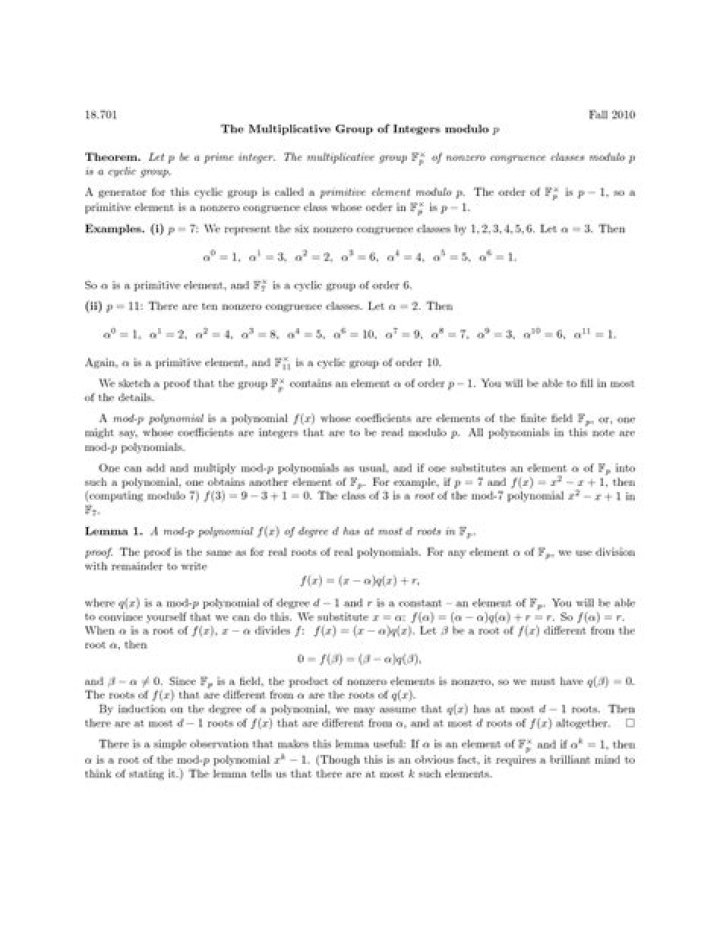
$\mathbb{Z}/7\mathbb{Z}=\{1,2,3,4,5,6\}$.
$6\times 6=1~{\rm mod}~ 7$ implies $6$ is an element of order $2$; however, we know that $\mathbb{Z}/7\mathbb{Z}\cong C_7$, not containing an element of order $2$.
I found it incredibly confusing, what have I missed? Any help will be appreciated.
$\endgroup$ 13 Answers
$\begingroup$$\mathbf Z/7\mathbf Z\simeq C_7$, yes, but $$\{1,2,3,4,5,6\}=(\mathbf Z/7\mathbf Z)^{\color{red}\times}\simeq C_6,$$ hence it has elements of orders $2$ and $3$, as a cyclic (multiplicative) group.
$\endgroup$ $\begingroup$$\mathbb{Z}_7$ is isomorphic to $C_7$ if the operation over $\mathbb{Z}_{7}$ is addiction.
Note that in your case, $|\mathbb{Z}_{7}|=6$.
$\endgroup$ $\begingroup$The multiplicative group modulo a prime $n$ and a group opperator of multiplication and the element $0$ removed is equivalent to an additive group modulo $n-1$ with zero in.
$A=\mathbb Z/7\mathbb Z-\{0\}^{\times}\cong B=\mathbb Z/6\mathbb Z^{+}$
$1 \to 0$ because $1\times a = a \to 0 + a = a$.
$5 \to 1$ because then $A = <5> = \{5^0,5^1,5^2,5^3,5^4,5^5\} = \{1,5,4,6,2,3\}$ $\to$ $B = <1> = \{0,1,1+1,1+1+1,1+1+1+1,1+1+1+1+1\} = \{0,1,2,3,4,5,\}$.
$4 \to 2$ because $5\times 5 = 4 \to 1+1 = 2$.
$6 \to 3$ beacause $5\times 4 = 6\to 1+2 = 3$ and because $6\times 6=1\to 3+3 = 0$.
$2\to 4$ because $5\times 6 = 4\times 4 = 2 \to 1+3 = 2+2 = 4$ and because $2\times 4 = 0 \to 4+2 = 0$.
$3\to 5$ because $5\times 2=4\times 6 = 3 \to 1+4=2+3 = 5$ and because $3\times 5 = 1 \to 5 + 1 = 6$.
$\endgroup$