Modus Ponens Proof
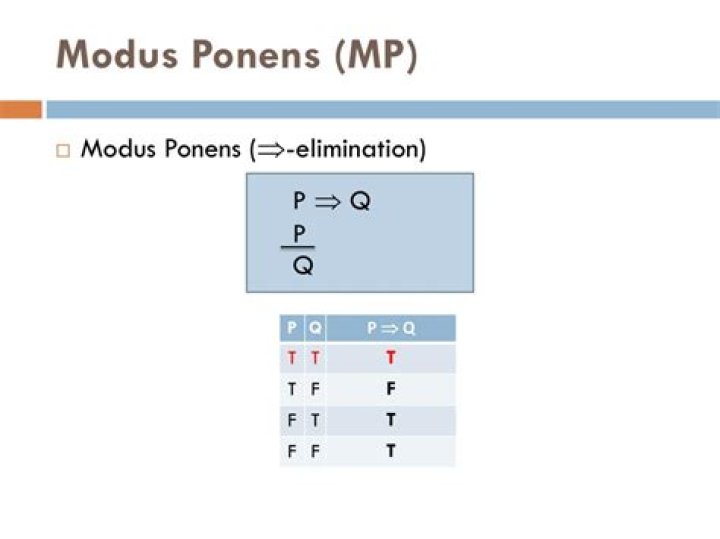
I have written the truth table for all of the forms of $P$ and $Q$.
Then maintained the table to find $P \rightarrow Q $ and $[(P \rightarrow Q) \wedge P]$.As we know, we can write arguments in forms of $[Expression_{one} \wedge Expression_{two}]\rightarrow Result $
Right now, I have the table with all possible forms of $P$ and $Q$ which leads to their conclusions.How can I prove that Modus Ponens is a valid argument according to the table I have written?
Thanks in advance
3 Answers
$\begingroup$Modus ponens rule is :
from $P \rightarrow Q$ and $P$, infer $Q$.
This rule correspond to the soundness of the "argument" :
$P \rightarrow Q, P \vDash Q$
where an argument is sound when, from true premises, licences the derivation of a true conclusion.
This means that modus ponens is equivalent to :
$\vDash ((P \rightarrow Q) \land P) \rightarrow Q$,
i.e. $((P \rightarrow Q) \land P) \rightarrow Q$ is a tautology.
Thus, as said in the above answer, you can check it with a truth table.
$\endgroup$ $\begingroup$When you have a truth table for $(P \to Q) \wedge P$ note that whenever the whole statement is true, $Q$ is also true.
$\endgroup$ 2 $\begingroup$It is simple: Basically, if Modes Ponens is a valid inference rule, then whenever we know some P implies Q, and at the same time we know that P happened to be true, then Q must be true. So, basically,
the Modes Ponens is this statement: (((P => Q) & P) => Q)
And that statement should, at the end (i.e., in the last column of the last Q, be TRUE for all truth values of P and Q, and it will). Do the truth table for the above statement
There's another branches of mathematics that also verify the validity of Modes Ponens (e.g, probability theory and set theory). if you like I can supply the simple proof there too.
$\endgroup$