Maximum area of isosceles triangle with perimeter 6 cm
Problem. What is the side lengths of an isosceles triangle with $6cm$ perimeter which has the largest area?
I solved this problem as below and I would like to learn that if there is anything wrong:
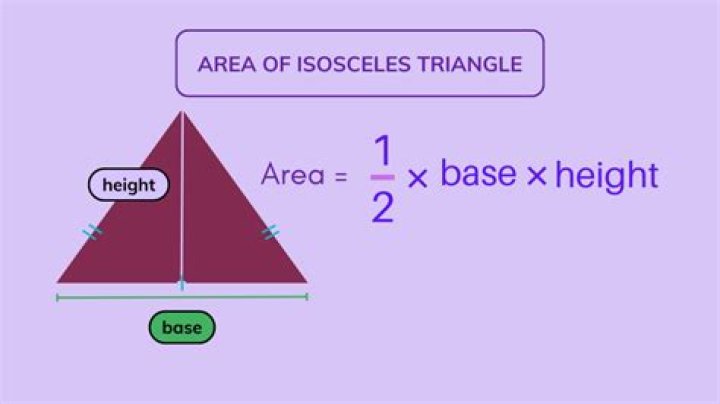
Let us say that the side lengths are $a$ and the bottom length is $6-2a$. By using pythagorean theorem we can conclude that the height $h$ is equal to $\sqrt{6a-9}$. Then, the area of the triangle can be given as $f(a)=(3-a)(\sqrt{6a-9})$. So $f'(a)=-\sqrt{6a-9}+\cfrac{3}{\sqrt{6a-9}}$. Finally, $f'(a)=\cfrac{12-6a}{\sqrt{6a-9}}$ and $f'(a)=0 \iff a =2$.
$\endgroup$ 24 Answers
$\begingroup$hint to avoid square roots
Let $a,a,6-2a $ be the three lengths.
By Pythagoras, the height $h $ is such that
$$h^2=a^2-(3-a)^2 $$
the square of the area is
$$A(a)=(3-a)^2 (6a-9) $$ the maximum is attained when $A'(a)=0$. $A'(a)=0$ gives $a=2$ or $a=3$ but $A (3)=0$. the maximum area is obtained by symetry in an equilateral triangle $(2,2,2) $.
$\endgroup$ 1 $\begingroup$The idea is correct but the calculation is wrong
$$f'(a)=-\sqrt{6a-9}+\frac{3(3-a)}{\sqrt{6a-9}}\to f'(a)=\frac{18-9a}{\sqrt{6a-9}}=0\to a=2$$
$\endgroup$ $\begingroup$Hint
As we need $3-a>0,6a-9>0$
$$\dfrac{6n\cdot\dfrac{3-a}n+m\cdot\dfrac{6a-9}m}{6n+m}\ge\sqrt[6n+m]{\left(\dfrac{3-a}n\right)^{6n}\left(\dfrac{6a-9}9\right)^m}$$
We need $\dfrac{6n}m=\dfrac1{\dfrac12}\iff m=3n$
Set $n=1\iff m=?$
$\endgroup$ $\begingroup$We can show this for any triangle that the area is maximum for the Equilateral case
Using Heron's formula, $\triangle^2=s(s-a)(s-b)(s-c) $
Using $AM\ge GM$, $$\frac{s-a+s-b+s-c}3\ge \{(s-a)(s-b)(s-c)\}^\frac13$$
or $(s-a)(s-b)(s-c)\le (\frac s3)^3$ the equality occurs when $s-a=s-b=s-c$ ie when $a=b=c$
$\endgroup$