Matrix notation $i$ $j$
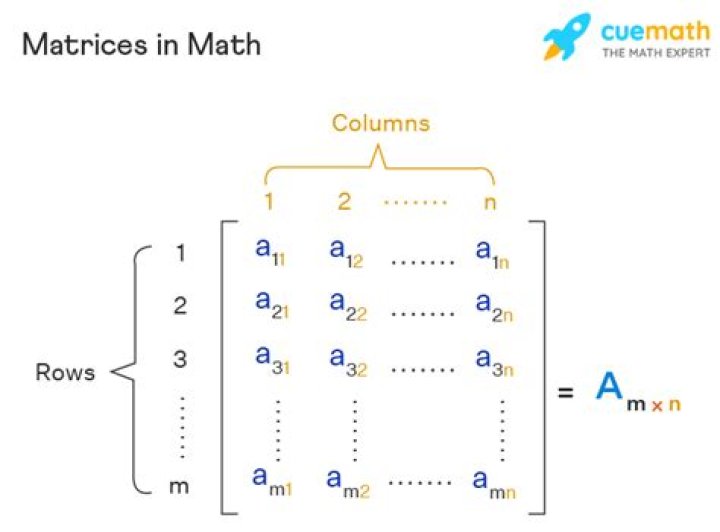
Let $A = \begin{bmatrix} a_1 & a_2 & \cdots & a_n \\ \end{bmatrix}$ be a $n \times n$ matrix such that $a_i \cdot a_i = 1$ for all $i$ and $a_i \cdot a_j = 0$ for all $i \neq j$.
I'm familiar with $i$ indicating row and $j$ indicating column but I'm not sure what these dot products actually refer to.
Let's say we have $B = \begin{bmatrix} \frac{1}{\sqrt2} & \frac{1}{\sqrt2}\\ -\frac{1}{\sqrt2} & \frac{1}{\sqrt2}\\ \end{bmatrix}$.
What does $a_i \cdot a_i =1$ and $a_i \cdot a_j = 0$ mean here?
$\endgroup$ 23 Answers
$\begingroup$In this case the $a$’s are the columns of the matrix, so $a_i\cdot a_j$ is the dot product of its $i$th and $j$th columns.
$\endgroup$ 2 $\begingroup$Such $B$ doesn't fulfill your constraints. Perhaps you intended$$B=\begin{bmatrix}\dfrac{1}{\sqrt 2}&-\dfrac{1}{\sqrt 2}\\\dfrac{1}{\sqrt 2}&\dfrac{1}{\sqrt 2}\end{bmatrix}$$here we define $$a_m=\begin{bmatrix}b_{1m}\\b_{2m}\\.\\.\\.\\b_{nm}\end{bmatrix}\qquad,\qquad \forall m$$and $$a_i\cdot a_j=\sum_{k=1}^{n}b_{ki}b_{kj}$$
$\endgroup$ $\begingroup$No, it's not like $i$ is for rows and $j$ is for columns. In your case $a_i, a_j$ are both column vectors:
$$ a_i =\left[\begin{matrix} a_{1,i} \\ a_{2,i} \\ \ldots \\ a_{n,i} \\ \end{matrix}\right] $$
So the notation $A = \begin{bmatrix} a_1 & a_2 & \cdots & a_n \\ \end{bmatrix}$ is equivalent to:
$$ A = \begin{bmatrix} {\left[\begin{matrix} a_{1,1} \\ a_{2,1} \\ \ldots \\ a_{n,1} \\ \end{matrix}\right]} & {\left[\begin{matrix} a_{1,2} \\ a_{2,2} \\ \ldots \\ a_{n,2} \\ \end{matrix}\right]} & \ldots & {\left[\begin{matrix} a_{1,n} \\ a_{2,n} \\ \ldots \\ a_{n,n} \\ \end{matrix}\right]} \end{bmatrix} = \begin{bmatrix} a_{1,1} & a_{1,2} & \dots & a_{1,n} \\ a_{2,1} & a_{2,2} & \dots & a_{2,n} \\ \vdots & \vdots & \ddots & \vdots & \\ a_{n,1} & a_{n,2} & \dots & a_{n,n} \\ \end{bmatrix} $$
and the product $a_i \cdot a_j$ means just a standard dot product of two vectors.
$\endgroup$ 10