Maclaurin polynomial of $\ln(1+x)$
My book is demanding that I show that the Maclaurin polynomial for $\ln(1+x)$ is
$$T_n (x) = x - \frac{x^2}{2} + \frac{x^3}{3}+ \cdots + (-1)^{n-1} \frac{x^n}{n}$$
I don't think this is true at all actually. Following the given formula for finding this
$$f(a) + \frac{f'(a)}{1!}(x)+\cdots$$
well just those two terms fail the test.
$a$ is zero so $\ln0$ is undefined. For the next part I get 1 which is also not on here. What is going on here? My book is suggesting that this is correct but I don't see that.
$\endgroup$ 13 Answers
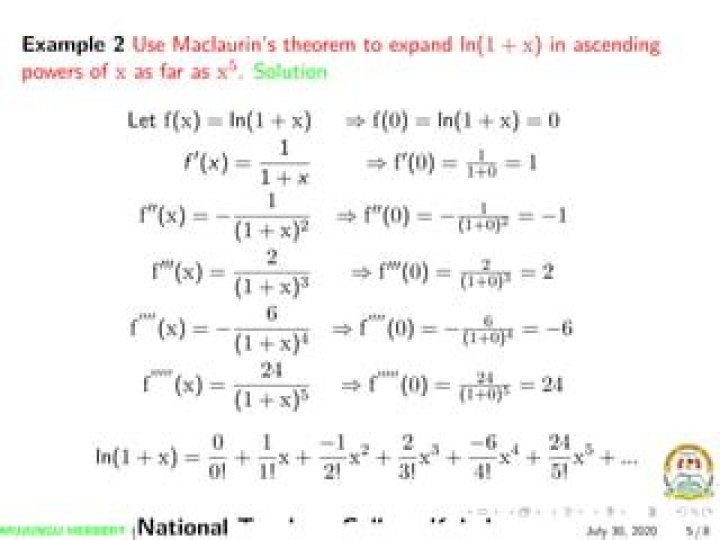
$\begingroup$Although $a$ is zero, that doesn't mean that $f(a)$ isn't defined. Recall that $f(x) := ln(1 + x)$, so that $f(0) = ln(1) = 0$.
Similarly, $f'(x)) = \frac{1}{x + 1}$, so $f'(0) = 1$.
--
Edit: For clarification, the formula for a Maclaurin series states that
$$f(x) = f(0) + \frac{f'(0)}{1!}x + \frac{f''(0)}{2!}x^2 + ...$$
In this case, $f(x)$ was defined as
$f(x) = ln(1 + x)$
Hence, we see that $f(0) = 0$, $f'(0) = 1$, and $f''(0) = -1$. Thus,
$$f(x) = 0 + \frac{1}{1} x + \frac{-1}{2} x^2 + ... = x - \frac{x^2}{2} + ...$$
as was desired.
$\endgroup$ 8 $\begingroup$Your book is correct. $f(0) = \ln{(1+0)} = \ln{1} = 0$. As for the other coefficients,
$$f'(0) = \frac{1}{1+x}|_{x=0} = 1$$
$$f''(0) = -\frac{1}{(1+x)^2}|_{x=0} = -1$$
etc. You can easily bulid this up and verify your book's formula.
$\endgroup$ 3 $\begingroup$Useing the geometric series formula,
$$\sum_{k=0}^{n-1}x^k=\frac{x^n-1}{x-1}$$
Under the substitution $x:-t$, and then integrating with respect to $t$ from $0$ to $x$ we get, $$\ln(x+1)=\sum_{k=1}^n(-1)^{k-1}\frac{x^k}{k}+(-1)^n\int_{0}^x\frac{t^n}{t+1} dt$$
But, $$(-1)^n\int_{0}^x\frac{t^n}{t+1}dt<\int_{0}^xt^{n-1}=\frac{x^n}{n}$$
So we have, $$|\ln(x+1)-T_n(x)|<\frac{x^n}{n}$$
And if $|x|<1$, $\lim_{n\to\infty}\frac{x^n}{n}=0$
$\endgroup$ 1