Logic - What does a half T mean in logic?
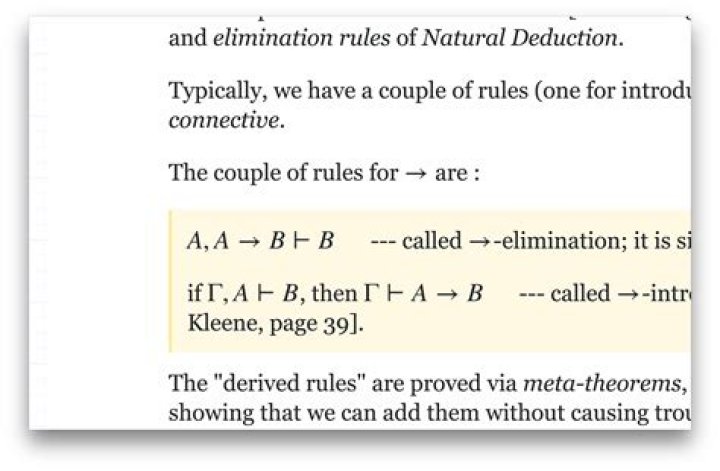
TLDR nevermind I'll include a screenshot;
I've looked for the symbol everywhere, it wasn't even found via wikipedia:
It also wasn't in the list of mathematical symbols:
There's a section called 'advanced and rarely used logical symbols' in the wiki page for logic, and it's not even there. So that is officially the point at which I give up.
I don't mean the symbols for True, T. The stem of the T by the way, remains untouched, it's just that the left side is 'cut off'.
Also, I would copy and paste the damn thing, but it's always added in via a super special way, and it just turns out like this: f Γ. So yeah.
$\endgroup$ 62 Answers
$\begingroup$In Sequent Calculus discussions, capital greek letters such as $\Gamma, \Delta, \Sigma,$ and $\Pi$, are often used as symbols for finite sets of first order predicate logic formula. (Pronounced "gamma", "delta", "sigma", and "pi".)
In this case the rule of implication introduction, means that "if some set of formula and $A$ entails $B$, then that set of formula entails that $A$ implies $B$." $${\begin{array}{rcl}\Gamma, A & \vdash & B \\\hline \Gamma&\vdash&A\to B\end{array}}{\small{\to}\mathsf I}$$
$\endgroup$ 2 $\begingroup$As others have pointed out, your "$T/2$" is the upper-case Greek letter gamma.
For the record, as I can't find it anywhere else on MSE, here is the Greek alphabet as supported by MathJax and $\LaTeX$ and used throughout mathematics. The format is:
$$ \begin{array}{llll} \mbox{Name} & \mbox{Upper-case glyph} & \mbox{Lower-case glyph} & \mbox{Variant glyph (if any)}. \end{array} $$
Use \Name for the upper-case letter and \name for the lower-case letter. Letters with a superscript 1 (like $A^1$) look like Latin letters, so they aren't useful as mathematical symbols and $\LaTeX$ and MathJax don't have a macro for them (you could try to defend notation like $H(H)$ by claiming that the second $H$ is an upper-case eta, but this is probably not going to make you popular $\ddot{\smile}$). Letters with a superscript 2 (like $\varphi^2$) are a variant lower-case form: use \varname for these.
$$ \begin{array}{llll} \mbox{Alpha} & A^1 & \alpha \\ \mbox{Beta} & B^1 & \beta \\ \mbox{Gamma} & \Gamma & \gamma \\ \mbox{Delta} & \Delta & \delta \\ \mbox{Epsilon} & E^1 & \epsilon & \varepsilon^2 \\ \mbox{Zeta} & Z^1 & \zeta \\ \mbox{Eta} & H^1 & \eta \\ \mbox{Theta} & \Theta & \theta \\ \mbox{Iota} & I^1 & \iota \\ \mbox{Kappa} & K^1 & \kappa \\ \mbox{Lambda} & \Lambda & \lambda \\ \mbox{Mu} & M^1 & \mu \\ \mbox{Nu} & N^1 & \nu \\ \mbox{Xi} & \Xi & \xi \\ \mbox{Omicron} & O^1 & o^1 \\ \mbox{Pi} & \Pi & \pi \\ \mbox{Rho} & P^1 & \rho \\ \mbox{Sigma} & \Sigma & \sigma & \varsigma^2 \\ \mbox{Tau} & T^1 & \tau \\ \mbox{Upsilon} & \Upsilon & \upsilon \\ \mbox{Phi} & \Phi & \phi & \varphi^2 \\ \mbox{Chi} & X^1 & \chi \\ \mbox{Psi} & \Psi & \psi \\ \mbox{Omega} & \Omega & \omega \end{array} $$
Corrections and comments welcomed.
$\endgroup$