Linear equation with no solutions (parallel lines) [closed]
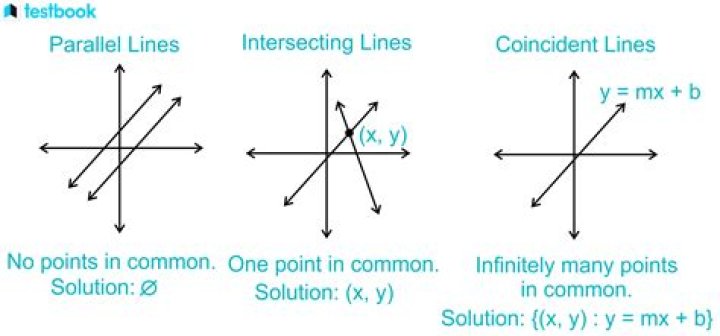
Suppose I have two equations
-x + y = 0
-x + y = -2
Suppose I don't know geometry, I don't know slopes, suppose I have just started reading algebraic equations .
after solving those above equation .. I will get stuck to
-2 = 0answer will be those equations don't have solutions...
But if I ask why? Why cant they have solutions. what will be the answer in terms of algebra.
I know -2 is not equal to 0 but those are mathematical values, but what is answer in terms of algebraic definition or anything?
$\endgroup$ 63 Answers
$\begingroup$Assume the reflexive property, x=x.$$ $$ y=x-2 $$ $$ y=x $$ $$ The reflexive property also says y=y. $$ $$ Therefore, x=x-2. $$ $$ This contradicts the reflexive property, x=x.$$ $$ For any solution to exist, it would have to contradict the reflexive property. But the reflexive property is a fundamental algebraic axiom, ergo no solution can exist.
$\endgroup$ $\begingroup$If you choose to not accept slopes / any geometric construction, then the best that I can think of in pure algebra is the number of common solutions between the lines.
If two lines are parallel, then they will never intersect (that is, they will have $0$ solutions in common).
If both the lines are the same line, then they will have infinite solutions in common.
If the lines are not parallel, then they will have $1$ unique solution in common
The number of solutions of a system of equations can be computed by writing the equation as a matrix equation
$$ A x = b $$
where $A$ is your coefficient matrix, $x$ is your vector of variables, and $b$ is your constants vector.
For this problem,
$$ -x + y = 0 \\ -x +y = -2 \\ \\ \begin{bmatrix}-1 & +1 \\ -1 &+1\end{bmatrix} \begin{bmatrix} x \\y \end{bmatrix} = \begin{bmatrix} 0 \\ 2 \end{bmatrix} $$
Hence,
$$ A = \begin{bmatrix}-1 & +1 \\ -1 &+1\end{bmatrix} \\ x =\begin{bmatrix} x \\y \end{bmatrix} \\ b = \begin{bmatrix} 0 \\ 2 \end{bmatrix} $$
The solution to the system $Ax = b$ is $x = A^{-1}b$. Hence, A must be invertible for solutions to exist
In our case, the determinant of $A$, $|A| = 0$ since it has the same row $\begin{pmatrix} -1 & +1 \end{pmatrix}$, hence the determinant will be $0$ and the matrix $A$ is non-invertible.
Since the matrix $A$ is non-invertible, but we need to achieve some non-zero value on the other side, the system of equations has no solution, and hence the lines are parallel
$\endgroup$ $\begingroup$There is no solution. This means there are no coordinates $(x,y)$ that satisfy both equations at the same time. This means there is is no point $P=(x,y)$ the can lie on both lines at the same time. Hence, the lines do not intersect. By definition the lines are parallel then.
$\endgroup$ 2