Linear Approximation and Volume of Cylinder
I was given the question:
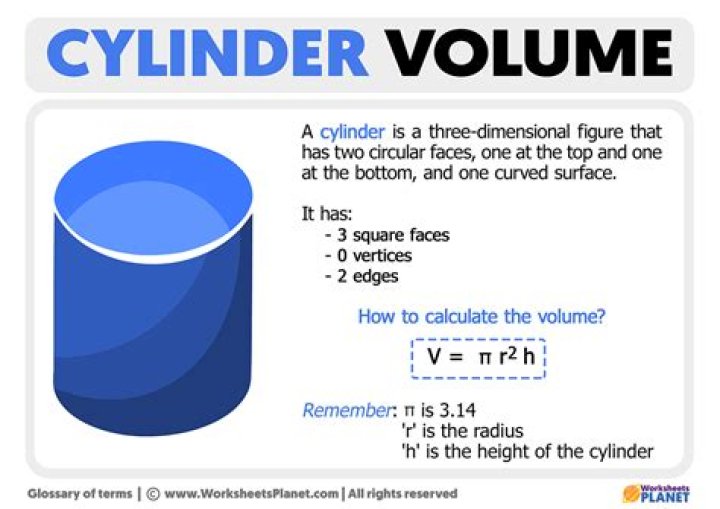
The volume V of a cylinder is computed using the values 6m for the diameter and 9.8m for the height. Use the linear approximation to estimate the maximum error in V if each of these values has a possible error of at most 7%.
I am unsure how to begin this problem. All I can assume is to use the volume formula. Any ideas?
$\endgroup$ 33 Answers
$\begingroup$$$ V= \pi r^2 h $$
$$ dV= \frac {dV}{dr} dr + \frac {dV}{dh} dh$$ $$ = (2\pi rh) dr + (\pi r^2)dh$$
$$ \frac {dV}{V} = 2(dr/r)+ (dh/h) = 2(.07)+ (.07) = 0.21 $$
Thus the relative error in $V$ is $21$ percent.
$\endgroup$ 1 $\begingroup$For this kind of problems, logarithmic dfifferentiation is quite useful$$V=\dfrac{\pi}{4}d^2\, h\implies \log(V)=\log\left(\dfrac{\pi}{4}\right)+2\log(d)+\log(h)$$ Take the partial derivatives $$\frac 1 V\frac{\partial V}{\partial d}=\frac 2 d\qquad \text{and}\qquad \frac 1 V\frac{\partial V}{\partial h}=\frac 1 h$$ Going from $\partial$ to $\Delta$ and adding the contributions, we then have $$\frac{\Delta V} V=2\frac{\Delta d } d+\frac{\Delta h } h$$ Since the relative errors are the same, then $\frac{\Delta V} V$ is three times the relative error on each dimension.
$\endgroup$ $\begingroup$Volume of a cylinder $V=\dfrac{\pi}{4}d^2\cdot h$
Possible error in volume $$=\frac{\pi}{4}[(1\pm0.007)d]^2[(1\pm0.007)h]$$ $$=\frac{\pi}{4}[(1\pm0.007)^3]d^2\cdot h$$ $$=v(1\pm0.07)^3$$ Now the percentage error in v $=1.225042$v $=>+22.5043$%
$\endgroup$ 5