Limits of combined functions Problem (Khan Academy)
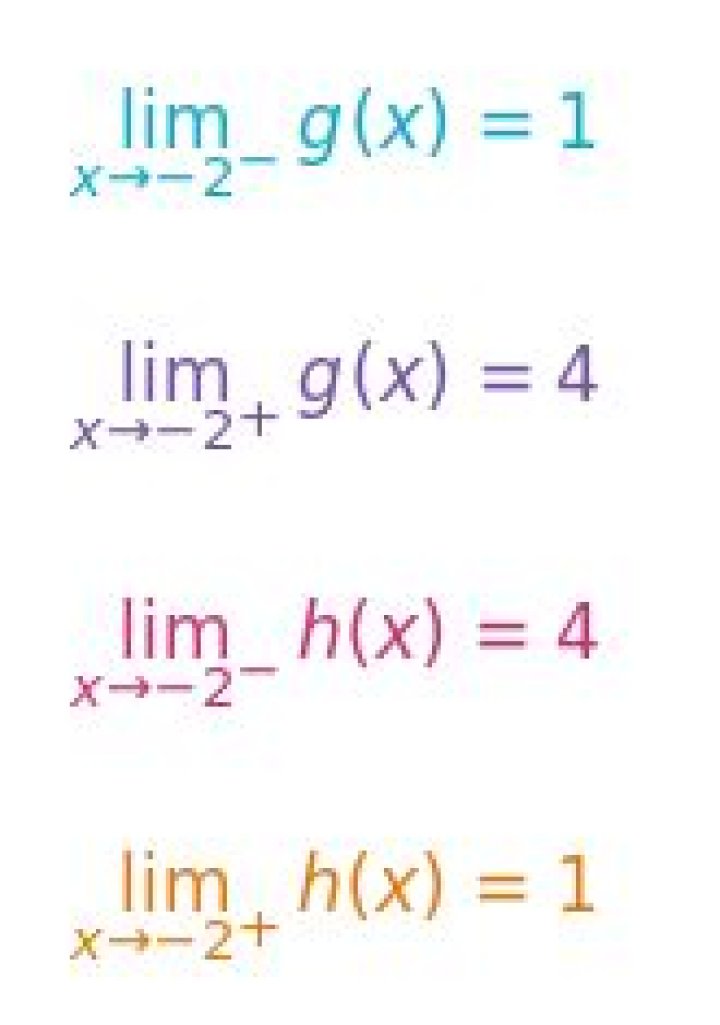
PROBLEM: Limits do not exist for both of the functions as $x \to -2$ but they say both functions still have fixed limit value equal to $5$. Is it one of the Limits Rules or more of common-sense approach ?
As you can see, for both $f(x), g(x)$ have different values for limits when approached from left and right sides, which mean they don't have a limit by definition. But if we add them together and take their limit it is $5$ for both left and right side. Hence, Khan Academy concludes this composite function does have a limit.
Can I assume that this is what it means:
Limits Rule for composite functions: if limits do not exist for 2 or more individual functions but added together they reach same value for both left-side and right-side limits, then limit exists.
$\endgroup$ 21 Answer
$\begingroup$Let $f(x)=g(x)+h(x)$, what we are interested would be the function $f$, rather than function $g$ or $h$.
We can then study $\lim_{x \to c^-}f(x)$ and $\lim_{x \to c^+}f(x)$ to decide if the limit exists at $c$. Limit need not exists at point $c$ for $g$ and $h$.
Remark:
The word composite usually refers to $f\circ g$, then that $f\circ g(x)=f(g(x))$.
$\endgroup$