Limit of a 0/0 function
Let's say we have a function, for example, $$ f(x) = \frac{x-1}{x^2+2x-3}, $$ and we want to now what is $$ \lim_{x \to 1} f(x). $$ The result is $\frac{1}{4}$.
So there exists a limit as $x \to 1$.
My teacher says that the limit at $x=1$ doesn't exist. How is that? I don't understand it. We know that a limit exists when the one sided limits are the same result.
Thank you!
$\endgroup$ 33 Answers
$\begingroup$It's possible that your teacher was pointing out the fact that the function doesn't exist at $x = 1$. That's different from saying that the limit doesn't exist as $x \to 1$. Notice that by factoring, $$ f(x) = \frac{x-1}{x^2 + 2x - 3} = \frac{x-1}{(x-1)(x+3)} $$
As long as we are considering $x \ne 1$, the last expression simplifies: $$ \frac{x-1}{(x-1)(x+3)} = \frac{1}{x+3}. $$ In other words, for any $x$ other than exactly $1$, $$ f(x) = \frac{1}{x+3}. $$ This helps understand what happens as $x$ gets ever closer to $1$: $f(x)$ gets ever closer to $$ \frac{1}{(1) + 3} = \frac{1}{4}. $$
$\endgroup$ 4 $\begingroup$Your teacher is not correct. There are two easy ways to do this problem. The first is by factoring the denomiator:
$$\lim_{x\to 1}\frac{x-1}{(x-1)(x+3)}=\lim_{x\to 1}\frac{1}{x+3}=\frac{1}{4}$$
The second is by using L'Hospital's rule, which is a useful identity in limits. By L'Hospital's rule, we know that
$$\lim_{x\to 1}\frac{x-1}{x^2+2x-3}=\lim_{x\to 1}\frac{1}{2x+2}=\frac{1}{4}$$
This limit exists, because it is simply a discontinuity in the function, but it is a discontinuity at a single point. When we have certain indeterminate forms in limits, we may apply L'Hospital's rule, which allows us to better compute the limit.
L'Hospital's rule states that, in certain indeterminate forms:
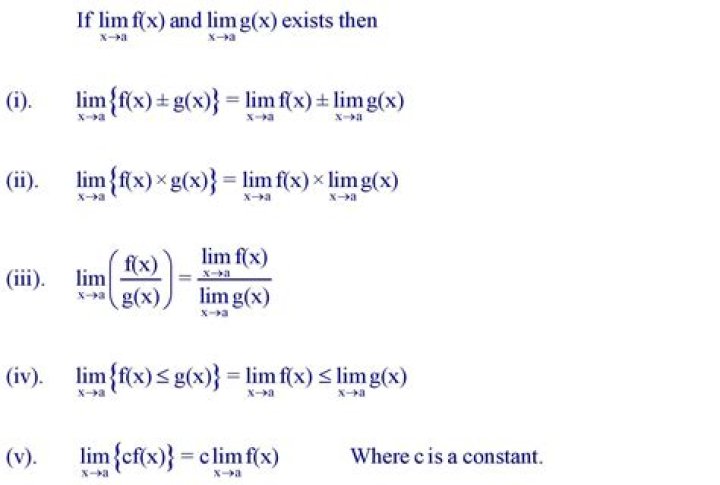
$$\lim_{x\to n}\frac{f(x)}{g(x)}=\lim_{x\to n}\frac{f'(x)}{g'(x)}$$
It is worth clearing up a particular misconception that seems to have arisen. For $$f(x)=\frac{x-1}{x^2+2x-3}$$ we cannot compute the value of $f(1)$, because this results in an indeterminate form. However, the limit exists, because there is simply a local discontinuity at a single point in an otherwise continuous function.
$\endgroup$ 7 $\begingroup$I don't know what your teacher means exactly. Limits are defined when $x$ tends to some number, or infinity. Not when $x$ is this number.
The value that the function takes at the limit poit is irrelevant (to compute the limit). In fact, in most high school limit exercises, the function is not defined at the point that $x$ tends to.
$\endgroup$