Length of line segment from point in circle to circumference
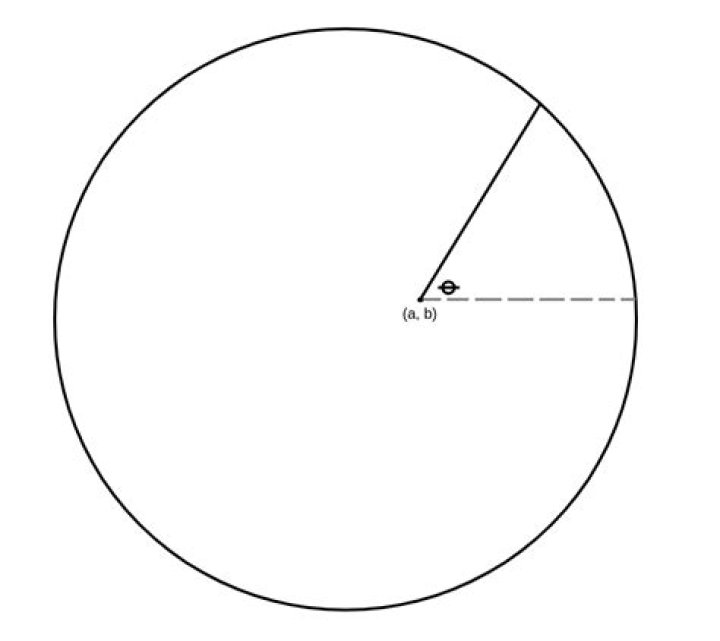
Given a circle centered at $(0, 0)$ with known radius $r$, a point in the circle at $(a, b)$, and an angle $\theta$ (wrt the horizontal axis), is it possible to find the length of the line segment from $(a, b)$ to the circumference of the circle at angle $\theta$?
My initial approach was to construct a scalene triangle using the radius, the line segment of interest, and a line segment from the origin to $(a, b)$. With that I would have 2 of the side lengths known, but I don't think it's enough information to solve using law of cosines. Any help would be appreciated.
$\endgroup$ 31 Answer
$\begingroup$For simplicity, let's assume that the angle $\theta$ is restricted to be in $[0,\frac{\pi}{2}]$, meaning that you always look to the right and up. Let $A(a,b)$ be the point you are given (and assume that $a^2+b^2<R^2$) and let $B,C$ be on the circle such that $B$ is on the line horizontal from $A$, so $B(\sqrt{R^2-b^2},b)$ (again assuming that you look to the right when doing the construction) and $C(\sqrt{R^2-x^2},x)$ is such that $\mu(\widehat{BAC})=\theta$.
Now this will get a little ugly with analytic geometry, but such is life.
We want to write the area of $\triangle ABC$ in two ways. This will give $\frac{AB\cdot AC \sin{\theta}}{2}=\frac{AB\cdot(x-b)}{2}$, where we used the sine area law on the LHS and the fact that the height corresponding to the edge $AB$ is just $x-h$ ($x>b$ as we assumed $\theta>0$). Simplifying this means $AC=\frac{x-b}{\sin{\theta}}$.
On the other hand, we can write down the length of $AC$. $AC^2=(\sqrt{R^2-x^2}-a)^2+(x-b)^2$, so we are left to solve the equation\begin{equation*} (\sqrt{R^2-x^2}-a)^2+(x-b)^2=\frac{(x-b)^2}{\sin^2{\theta}} \end{equation*}or equivalently\begin{equation*} (\sqrt{R^2-x^2}-a)^2=\Big(\frac{(x-b)}{\tan{\theta}}\Big)^2. \end{equation*}
Since we restricted $\theta\in[0,\frac{\pi}{2}]$, we can take square roots without worrying about signs, so we reduce to\begin{equation*} \sqrt{R^2-x^2}=a+\frac{x-b}{\tan{\theta}}. \end{equation*}
Squaring this should lead to degree two equation for $x$, and then we can get the length $AC$ as $\frac{x-b}{\sin{\theta}}$.
And if $\theta=\frac{\pi}{2}$, one immediately sees that $\sqrt{R^2-x^2}=a$ and can solve this for $x$.
$\endgroup$ 2