Largest possible sphere is inscribed in a cube. What percentage is the volume of the sphere smaller than the volume of the cube?
Largest possible sphere is inscribed in a cube. What percentage is the volume of the sphere smaller than the volume of the cube?
I have already found out:
- volume of the cube is $X^3$
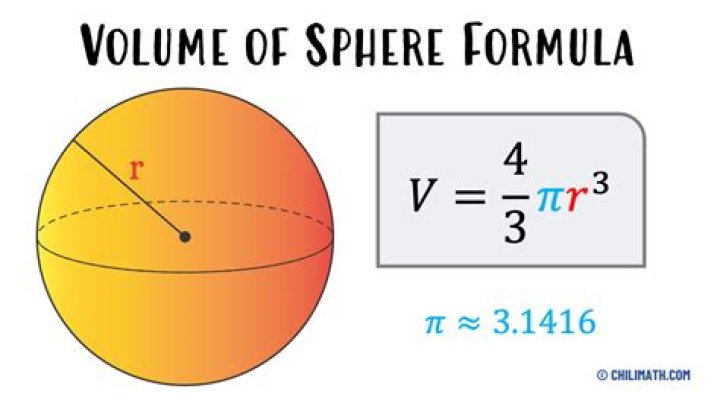
- volume of the sphere is $4/3\times \pi\times \text{radius}^3$
- area of cube is $6X^2$
- area of sphere is $4\times\pi\times \text{radius}^2$
Should I find the ratio next and then replace X?
Thank you for all your help.
$\endgroup$ 12 Answers
$\begingroup$If $s$ is the side length of the cube, we have that $V_{\text{cube}} = s^{3}.$ Notice that the largest possible sphere that can fit inside the cube is the inscribed sphere, which has radius $\frac{1}{2}s.$ Using the volume formula for a sphere, we find that $V_{\text{sphere}} = \frac{4}{3}\pi r^{3} = \frac{4}{3}\pi \frac{s^{3}}{8} = \frac{\pi}{6}s^{3}.$
To find the percentage, we must first find the ratio between the sphere and the cube. This is simply $\frac{\frac{\pi}{6}s^{3}}{s^{3}} = \frac{\pi}{6}.$ The sphere is $1 - \frac{\pi}{6} = \boxed{47.6\%}$ smaller than cube.
$\endgroup$ $\begingroup$It's a good question!
Our conditions:
- A ball fits inside a box;
- The ball is a perfect sphere and the box is a perfect cube;
- The diameter of the ball is equal to the length of the box.
Question: If the length of the box is 1 unit, what is the ratio of the volume of the sphere with the volume of the box?
Well, first, we can know that the volume of the box is equal to 1 unit cubed:
$$V_{box}=1$$
We also can know that the radius of the sphere is equal to 1/2 units
$$r=1/2$$
And we know that the equation for a sphere is given as
$$V_{sphere}=\frac{4 \pi r^3}{3}$$
Substituting in our radius we have
$$V_{sphere}=\frac{4 \pi}{3*8} = \frac{\pi}{6}$$
And now taking the volume ratio of the ball to the box, we get:
$$\frac{V_{sphere}}{V_{box}}=\frac{\pi/6}{1}=\frac{\pi}{6}$$
Therefore the ratio of our sphere to our box is:
$$\frac{\pi}{6}$$
$\endgroup$