Laplace transform of $1/t$
Does the laplace transform of $1/t$ exist? If yes, how do we calculate it? Putting it in $$\int_0^\infty (e^{-st}/t) dt$$ won't solve.
Is there any other way? If not, why?
Thanks!
$\endgroup$ 23 Answers
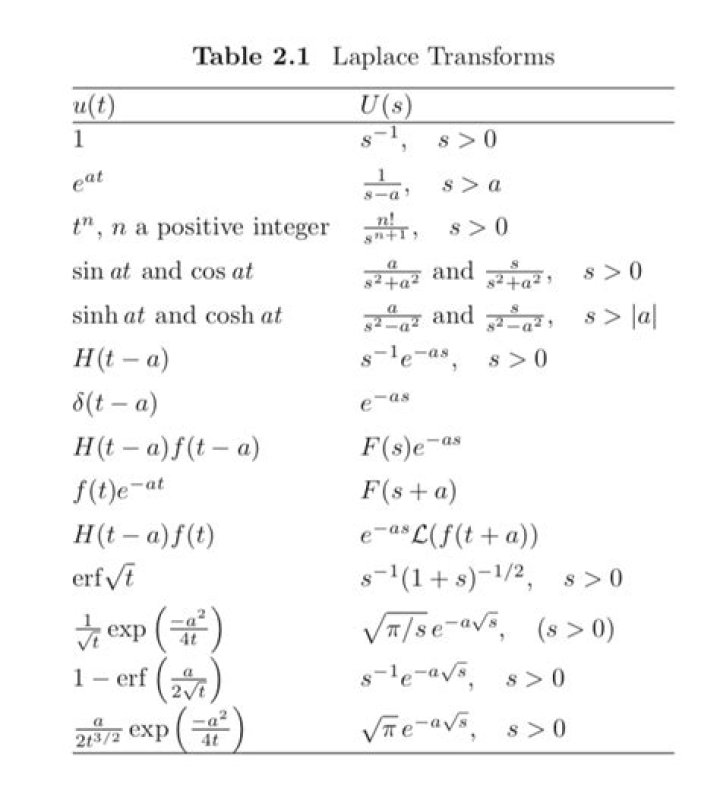
$\begingroup$No, it doesn't exist. In general the Laplace transform of $t^n$ is $\frac{\Gamma(n+1)}{s^{n+1}}$, and $\Gamma(n)$ isn't defined on $0,-1,-2,-3...$ This integral is the definition of the Laplace transform, so the transform doesn't exist if the integral doesn't. While there are other integral transforms that could transform $\frac{1}{t}$ in a useful way, anything other than what you gave wouldn't be considered a Laplace transform anymore.
$\endgroup$ 1 $\begingroup$You can actually simplify it further by substituting $st = x$, so you'll get
$$L \left(\frac 1 t \right) = \int \limits _0 ^\infty \frac {\Bbb e ^{-x}} x \ \Bbb d x$$
which is a divergent integral. In other words, the transform doesn't converge for any value of $s$.
$\endgroup$ 0 $\begingroup$$L\left[\frac{f(t)}{t}\right](s)=\int_s^{+\infty}f(u)du$ so $L\left[\frac{1}{t}\right](s)=\int_s^{+\infty}\frac{du}{u}=\ln u|_s^{+\infty}=\ln(s)-\ln(+\infty)$ as $\ln(+\infty)$ is not defined, then $L\left[\frac{1}{t}\right]$ is also not defined but it can be solved when $L\left[\frac{1}{t}-\frac{\cos t}{t}\right]$ or more .
$\endgroup$