Joint density of two exponential random variables
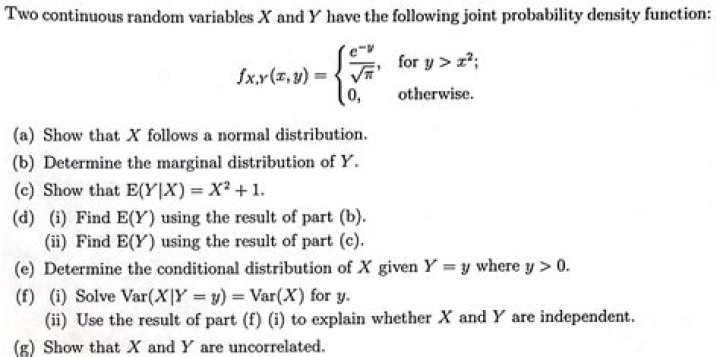
For independent random variables X ∼ Exp(1) and Y ∼ Exp(2), find the density of (Z, W) = (X-2Y, X).
My approach:
Since for any exponential distribution with parameter $\lambda$ the function is$f(x) = \lambda e^{-\lambda x}$
$f_X(x) = e^{-x}$
$f_Y(y) = 2e^{-2y}$
Therefore the joint density function is: $$ f_{X, Y}(x, y) =f_X(x) f_Y(y) = \begin{cases} 2e^{-x-2y} \ & \mbox{ if } x \geq 0, y \geq 0; \\ 0 \ & \mbox{ elsewhere}. \end{cases} $$
However I don't know how to use this to calculate $f_{Z, W}$
$\endgroup$ 23 Answers
$\begingroup$The map $g:(x,y) \mapsto (x-2y,x)$ is a differentiable and invertible function between $(0,\infty)\times (0,\infty)$ and $R=\{(z,w) | z< w \text{ and } w>0\}$, so first of all we get that the support for $(Z,W)=(X-2Y,X)$ must be $R$.
The transformation theorem for probability densities states that:
$$f_{Z,W}(z,w) = f_{X,Y}(g^{-1}(z,w)) |det(\frac{dg^{-1}}{d(z,w)}(z,w))|,$$where $\frac{dg^{-1}}{d(z,w)}(z,w)$ is the jacobian of $g^{-1}$.
(see )
We first compute $g^{-1}(z,w)= (w,\frac{w-z}{2})$ and the jacobian$$ \frac{dg^{-1}}{d(z,w)}(z,w) = \begin{pmatrix}0 & 1 \\ -\frac12 & \frac12 \end{pmatrix},$$which has determinant $\frac12$ for all $z,w$. We now plugin, and get$$ f_{Z,W}(z,w) = \frac12 f_{X,Y} ((w,\frac{w-z}{2})) = e^{-w}e^{-2\frac{w-z}{2}}=e^{z-2w}.$$for all $(z,w) \in \{(z,w) | z< w \text{ and } w>0\}$. Just to verify, that this is in fact a valid density we compute $$ \int_0^\infty \int_{-\infty}^w e^{z-2w} dzdw = 1$$
$\endgroup$ $\begingroup$Note that while $X$ and $Y$ are nonnegative, $X-2Y$ may take negative values. So we need to treat these cases separately. For $t<0$, we have\begin{align} F_Z(t) &= \mathbb P(Z\leqslant t)\\ &= \mathbb P(2Y\geqslant X-t)\\ &= \int_0^\infty\int_{x-t}^\infty \lambda e^{-\lambda x}\frac\mu 2 e^{-\frac\mu 2y}\ \mathsf dy\ \mathsf dx\\ &= \frac{2 \lambda e^{\frac{\mu t}{2}}}{2 \lambda +\mu }. \end{align}For $t>0$, we have\begin{align} F_Z(t) &= \mathbb P(Z\leqslant t)\\ &= 1 - \mathbb P(2Y\geqslant X-t)\\ &= \int_t^\infty \int_0^{x-t} \lambda e^{-\lambda x}\frac\mu 2 e^{-\frac\mu 2y}\ \mathsf dy\ \mathsf dx\\ &= 1-\frac{\mu e^{-\lambda t}}{2 \lambda +\mu }. \end{align}Differentiating yields the density of $Z$:$$ f_Z(t) = \begin{cases} \frac{\lambda \mu e^{\frac{\mu t}{2}}}{2 \lambda +\mu },& t<0\\ \frac{\lambda \mu e^{-\lambda t}}{2 \lambda +\mu },& t>0 \end{cases}. $$
$\endgroup$ $\begingroup$If I'm not wrong, you've formed the joint density function under the assumption that the random variables $X$ and $Y$ are independent.
In the formula for $f_{X,Y}(x,y)$, let us put $X-2Y$ in place of $X$, $X$ in place of $Y$, and let us also put $x-2y$ in place of $x$ and $x$ in place of $y$ to obtain$$ f_{Z, W}(z, w) = 2e^{- (x-2y) - x } = 2 e^{2y-2x} $$if $x-2y \geq 0$ and $x\geq 0$, that is, if $x \geq \max(2y, 0)$, and $0$ otherwise.
However, I'm not completely sure if my solution is correct.
$\endgroup$ 2