Is this histogram considered bimodal?
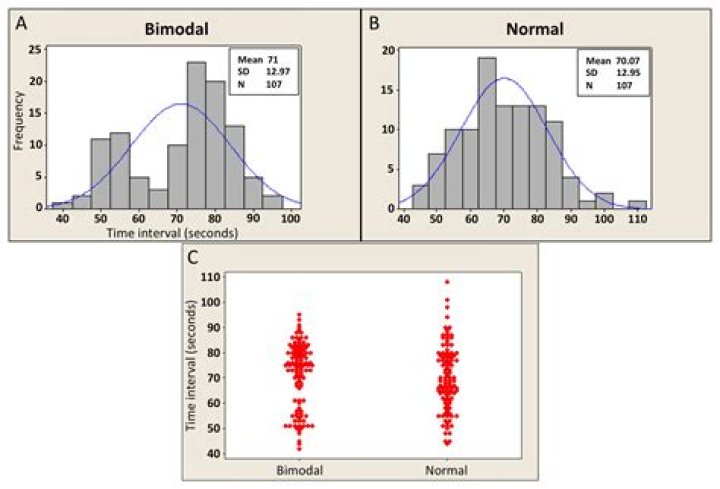
Is this histogram bimodal? Because when I google what a bimodal histogram looks like, I keep getting images that say histograms like these are considered bimodal.
Isn't it unimodal because the highest peak is the only mode? Am I misunderstanding something?
$\endgroup$ 42 Answers
$\begingroup$If you read "mode" literally then there is just one mode: the highest bar. But that's not what "bimodal" means. Your distribution is properly labelled bimodal since it has two distinct local modes, with a drop between them.
Here's an example that's close to a sum of two normal distributions (Hodgkin lymphoma diagnosis as a function of age).
The diagram is bimodal because it's a sort-of sum of two normal distributions. This can occur, for instance, if there are two sub-populations, say the one on the left is males and the one on the right is females. Then each of males and females is distributed normally, but when you combine them together, you get a composition of two normal distributions, hence "bimodal", instead of a single normal distribution.
Note that this definition is different from what is given in first-year statistics. For first-year statistics, "bimodal" is the opposite of "unimodal", whereas for the definition I explained, "bimodal" is the opposite of "normal".
$\endgroup$