Is this a proof of the Newton-Leibniz formula
Lets say we prove the fundamental theorem of calculus,$$F(x) = \int_a^xf(t)dt \Rightarrow F'(x) = f(x).$$
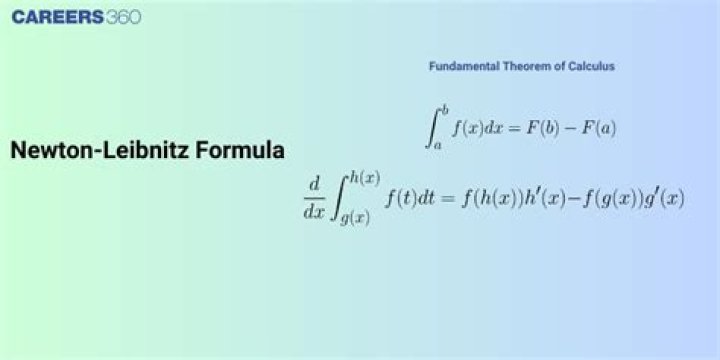
We now want to prove the Newton-Leibniz formula$$\int_a^b f(t)dt = F(b)-F(a).$$
Is it enough to simply say$F(b)-F(a) =\int_a^b f(t)dt - \int_a^af(t)dt$, where the equality is by dfinition of $F$ and the last term is obvious zero. Or is this proof circular?
$\endgroup$ 51 Answer
$\begingroup$In fact, your fundamental theorem calculus is
"If $f$ is continuous on $[a,b]$, then $\displaystyle F(x):= \int_a^x f(t) \, dt$ is differentiable on $[a, b]$ with $F'(x)=f(x).$"
And your Newton-Leibniz formula is
"Let $f$ be integrable on $[a, b]$. If there exists a function $G$ on $[a,b]$ with $G'(x)=f(x)$ then $\displaystyle \int_a^b f(t) \, dt = G(b) - G(a)$."
Note that the function $f$ in the second statement need not to be continuous! So $G$ need not to be equal to $F$ in the first statement! However, as we see below, they won't be "too different" from each other if we make an additional assumption that $f$ to be continuous.
Now let's prove the second statement with our additional assumption by using the first statement:
Let say $G$ be a function such that $G'(x) = f(x)$ on $[a, b]$. We also know from the first statement that $F'(x)=f(x)$ on $[a, b]$. Thus, $G'(x)=F'(x)$ on $[a, b]$. By the mean value theorem there is a constant $C$ such that $G(x) = F(x) + C$ on $[a, b]$. Hence,
$\displaystyle \int_a^b f(t) \, dt = F(b) = F(b) - 0 = F(b) - F(a) = [F(b) + C] - [F(a) +C] = G(b) - G(a)$.
$\endgroup$