Is this a circular proof of Pythagorean Theorem? If not, are there better ones? [duplicate]
I found this proof of Pythagorean Theorem from what 3Blue1Brown shows in his Lockdown math lecture "Trigonometry Fundamentals":
In the following right triangle, project $\cos\alpha$ and $\sin\alpha$ back to the hypotenuse of length $1$, they become $\cos^2\alpha$ and $\sin^2\alpha$:$\to\cos^2\alpha+\sin^2\alpha =1 $.
I thought this is what a simple, visual, and elegant proof! My questions:
- Is it a circular proof, why?
- If not, are there better ones?
I want clarity about whether or not this proof is circular. The argument only depends on the definition of the sine and cosine functions and nothing more (please correct me if I am wrong). This is why I love it. Many other geometry solutions involve more than three shapes.
$\endgroup$ 136 Answers
$\begingroup$This is a great question. The original proof-as-I-read-it is valid, but some proofs can be "better" or worse in other respects. (By "as I read it", I mean with the implication that it calculates projections with similar triangles as I describe below, rather than stating their values without proof.) There are many criteria for saying one proof is "better" than another, so I'll focus on one germane to this question: making it obvious to all readers that there's no circularity (spoiler alert: there isn't).
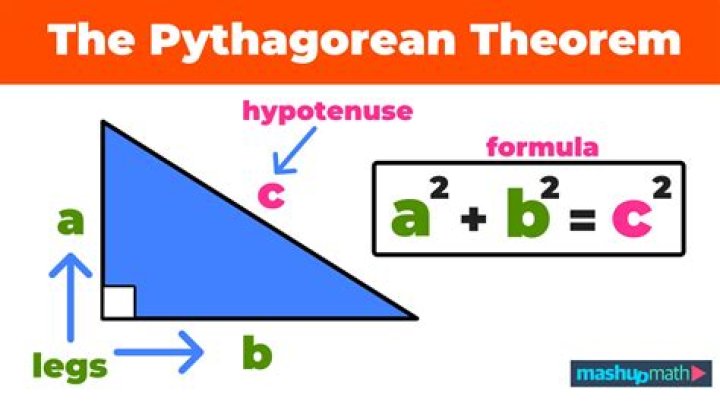
Let the legs adjacent to and opposite $\alpha$ have respective lengths $a,\,b$,and let $c$ denote the hypotenuse's length. By similar triangles, your projections are $c(a/c)^2,\,c(b/c)^2$. Since they sum to the full hypotenuse $c$, $a^2+b^2=c^2$.
Since we define $\cos\alpha,\,\sin\alpha$ respectively as $a/c,\,b/c$, the above calculation can be restated as$$c\cos^2\alpha+c\sin^2\alpha=1\implies c(a/c)^2+c(b/c)^2=1\implies a^2+b^2=c^2,$$which is basically what your proof does. (It takes $c=1$ throughout, but that just changes the units to tidy the algebra; it's not an extra assumption as such, so it covers the general case.) But as I've shown above, there's no need to work with anything other than rational functions of $a,\,b,\,c$. The trigonometric approach switches from such rational functions to something more conceptually advanced, then "uninstalls" the trigonometry later.
One could argue this is a worse proof than the one I've presented, because in taking unnecessary detours it not only asks more of us, it also obscures the underlying reasoning. Well, whether it does is a psychological question, but people mistakenly thinking it's circular suggests as much.
Well, I want to be fair with an edit: as best I can tell from recent comments, those people either didn't realize which proof strategy is implicit in the OP's discussion of projections, or are making the actually salient point that the drawing itself doesn't necessarily communicate that as clearly as one would like in a proof without words. But the facts are these:
- the proof can easily be spelled out in the aforementioned non-circular way,
- it takes a bit more work to do that than is obtained in at least some readings of the picture and the text above it, and
- none of these subtleties matter if we skip the trigonometry altogether, as aforesaid.
As nicely compact as the cited diagram is, I might be inclined ---as a matter of diagrammatic pedagogy--- to render things thusly:
This arrangement can help make clear(er) that
- "$\sin\theta$" and "$\cos\theta$" are effectively definitions (of particular ratios in a right triangle)
- "$\cos^2\theta$" and "$\sin^2\theta$" are consequences (via proportions in similar right triangles)
so that
- "$\cos^2\theta+\sin^2\theta=1$" is a deduction, not an assumption.
As a result, some (most? all?) of the confusion about the logical dynamics is mitigated. There's no circular argument here.
(Plus, as a matter of diagrammatic style, I find it's often preferable to avoid overlapping elements.)
The contention (dating back at least as far as to Loomis in the 1940s) that "no trigonometric proof [of the Pythagorean Proposition] is possible" seems to manifest in knee-jerk rejections of any argument that makes any reference whatsoever to sine or cosine. Granted, caution is advised when considering such things: once trig relations become second-nature to us all, it's all-too-easy for an author to inadvertently invoke a Pythagorean identity ... and for a reader to overlook the mistake. But, when caution is applied, it's certainly possible to construct a viable proof.
$\endgroup$ 2 $\begingroup$I find proofs like Andrea Marino's far more tangible (and, yes, I can go through the same existential questions of what is area; but in that type of proof I'm not compelled to). However.... maybe it's too practical and not abstract enough to be elegant.
The more I think and worry of the abstraction, the more I'm compelled to prefer a Euclid like proof of comparing two sets of rectangles, parallegrams, and squares. .... But I can hardly call those simple or elegant.
$\endgroup$ 1 $\begingroup$Harry Helson showed us this proof my first semester at Berkeley, using the dot product: $(x+y)\cdot(x+y)=x\cdot x+y\cdot y+2x\cdot y$, which gives the result when $x$ and $y$ are perpendicular.
I like even better the one where a square of side length $c$, the hypotenuse, is offset in a square of side length $a+b$, the sum of the lengths of the legs.
$\endgroup$ 2 $\begingroup$I hope the author wasn't regarding that picture as a proof of Pythagoras. Since trigonometry depends on the Pythagorean theorem, the above "demonstration" employs circular reasoning and wouldn't count as a valid proof. So yes, there are better proofs.
$\endgroup$ 19