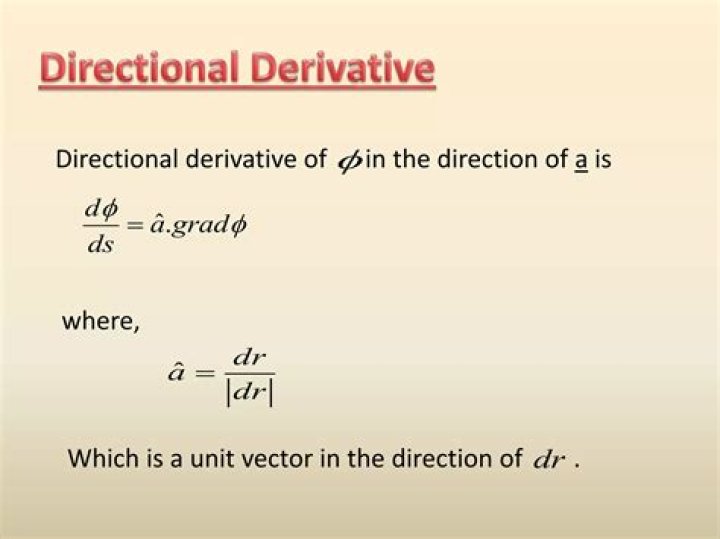
Is there a simple way of showing that the directional derivative is the dot product of grad(f) with the directional vector u?
I am reading a sort of technical proof but I would like to prove it myself in a cleaner and shorter way.
So, I want to show
$$D_uf = \nabla f. u$$
Any suggestions are greatly appreciated.
Thanks,
EDIT: I think I will try to work backwards, using matrix multiplication, since grad(f) can be viewed as a 1x2 matrix.
$\endgroup$ 23 Answers
$\begingroup$What is your definition of the gradient? In many cases $\nabla f$ is defined to be the vector with $\langle\nabla f, u\rangle = D_uf$. (It is then shown that this vector is well-defined, which follows immediately from linearity of $D$ with respect to $u$.)
The above definition has the great advantage of being coordinate-independent: it will work on any manifold with any metric, on functionals acting on function spaces (when suitably interpreted in terms of variations), etc. But perhaps you're in Euclidean space and have defined $\nabla f= \left(\frac{\partial f}{\partial x}, \frac{\partial f}{\partial y}, \ldots\right)$. You can show that this is equivalent to the definition above by taking $u$ to be the Cartesian basis vectors $e_i$ and then applying linearity of the directional derivative.
$\endgroup$ 5 $\begingroup$Hint: Suppose $f$ is differentiable at a point $a$. If $h > 0$, if $u$ is unit, and if $x := a + hu$ lies in some suitable open ball around $a$, then $$ \frac{|f(x) - f(a) - \nabla f(a)(x-a)|}{|hu|} = \frac{|f(a+hu) - f(a) - \nabla f(a)(hu)|}{h}\\ = \big| \frac{f(a+hu) - f(a)}{h} - \nabla f(a)u \big| \to 0 $$ as $h \to 0$.
$\endgroup$ 5 $\begingroup$For given point $p$ and direction $u$, $$f(x_p+tu_x,y_p+tu_y,z_p+tu_z)=\phi(t)$$ is a function of $t$ that indicates how $f$ evolves along the straight line through $p$ in the direction $u$.
Then by the chain rule,
$$\frac{d\phi}{dt}=\frac{\partial f}{\partial x}u_x+\frac{\partial f}{\partial y}u_y+\frac{\partial f}{\partial z}u_z=\nabla f\cdot u.$$
$\endgroup$ 3