Is there a shortcut to find a Taylor series not centered at 0 with a Taylor series centered at 0?
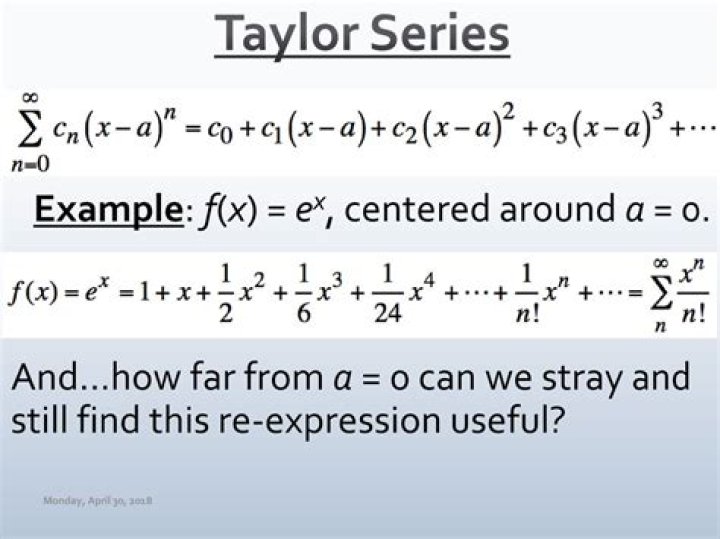
We know that the Taylor series of $\ln(1+x)$ centered at 0 is $x-\frac{x^2}{2} + \frac{x^3}{3} - \dots$.
We can find the Taylor series of $\ln(2+x)$ by writing $\ln(1+(1+x))$, so this is equal to $(x-1)-\frac{(x-1)^2}{2} + \frac{(x-1)^3}{3} - \dots$ but then this is centered at $-1$, since $1+x$ is centered at 0.
Other than calculating the derivatives and applying the general formula, is there a quicker way to find a Taylor series centered at $a \neq 0$ with the Taylor series centered at $0$? Or are is brute force the only method here?
$\endgroup$3 Answers
$\begingroup$There is no simple formula in general. You can't even find the value of $f(a)$ without using all the Taylor coefficients of the series around $x=0$.
However, in the case of $\ln$, you can say$$ \ln(2+x) = \ln(2 (1+x/2)) = \ln(2) + \ln(1+x/2)$$and substitute $x/2$ for $t$ in the series of $\ln(1+t)$.
$\endgroup$ $\begingroup$Given the equation
$y=f(x)$ with a Taylor series $y=\sum_k c_kx^k$ about $x=0,$ the equation function about $x=a$ is $y=f(x-a).$ Hence the Taylor series of this about $x=a$ is $$\sum_k d_k(x-a)^k.$$
In the case where $d_k\ne c_k,$ it is clearly not a neat problem.
$\endgroup$ 4 $\begingroup$The Taylor's series centered at $x=0$ is
$f(x)=f(0)+\frac{x}{1!}f'(0)+\frac{x^2}{2!}f''(0)+........$
The Taylor's series centered at $x=a$ is$f(x)=f(a)+\frac{(x-a)}{1!}f'(a)+\frac{(x-a)^2}{2!}f''(a)+........$
The problem is that there is no shortcut to predict the derivative $f'(a)$ if $f'(0)$ is known without computing the derivatives at $x=a$. Hence even for the same function $f(x)$, the task doesn't allow you to find some short cut.
$\endgroup$