Is there a general way to find domain and range for a quadratic equation without graphing?
I have a general question that I could like to ask is there a general way to find domain and range for a quadratic equation without graphing?
$\endgroup$2 Answers
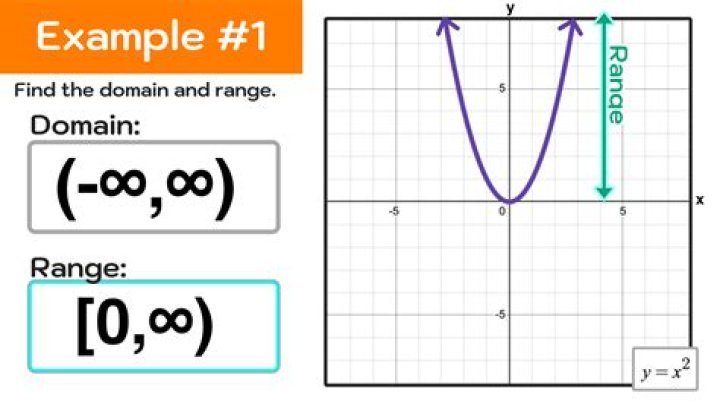
$\begingroup$We can compute $az^2+bz+c,\,a\neq 0$ for any $z$, so the domain is the entire set of numbers of interest, e.g. $\mathbb{R}$ or $\mathbb{C}$. The range depends on that choice. For example, if $a,\,b,\,c,\,z\in\mathbb{R}$ the identity $az^2+bz+c=a\left(z+\frac{b}{2a}\right)^2+c-\frac{b^2}{4a}$ implies the range of $az^2+bz+c$ is $\left[c-\frac{b^2}{4a},\,\infty\right)$ if $a>0$ or $\left(-\infty,\,c-\frac{b^2}{4a}\right]$ if $a<0$. By contrast, if $a,\,b,\,c,\,z\in\mathbb{C}$ then the range is the whole of $\mathbb{C}$.
$\endgroup$ $\begingroup$Assuming we're looking at quadratic function $\mathbb R \to \mathbb R$, the domain will always be $\mathbb R$, as a quadratic function is a polynomial.
For finding the range: Just find the extremum, determine whether the extremum is a maximum or minimum and deduce the range.
$\endgroup$