Is $\sqrt x$ continuous at $0$? Because it is not defined to the left of $0$
If a function has a limit from the right but not from the left, is it still continuous?
$\endgroup$ 33 Answers
$\begingroup$It is continuous at $0$.
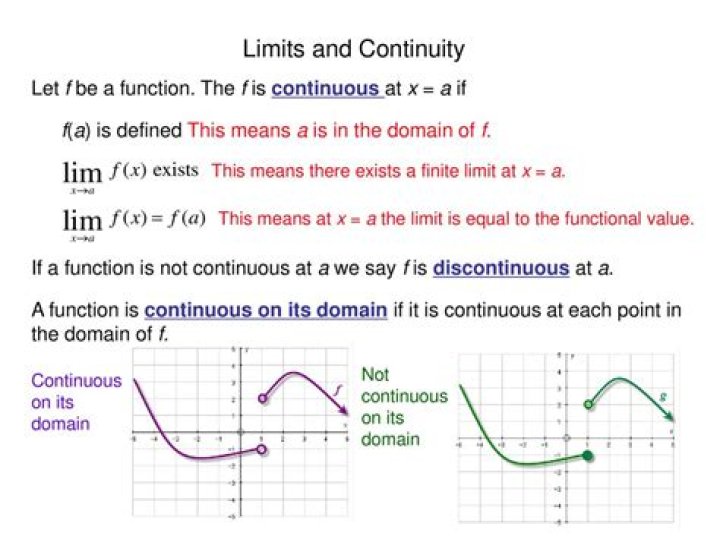
By construction, the domain of the square-root function is $\mathbb R_+=[0,\infty)$. Now, for any sequence $(x_n)_{n\in\mathbb N}$ in the domain (that is, $x_n\geq 0$ for all $n\in\mathbb N$) that converges to $0$, one has that the corresponding function values $\sqrt{x_n}$ also converge to $\sqrt{0}=0$.
And this is all you need for continuity by (one of the multiple equivalent) definition(s) of this concept in general metric spaces. What goes on “from the left” is outside of the domain and hence outside of interest as far as continuity is concerned.
$\endgroup$ 7 $\begingroup$One can only talk about continuity on the domain where the function exists. The function doesn't exist for $x < 0$ so we can't talk about limits for values $x < 0$.
$\sqrt x $ is continuous everywhere it exists.
$\endgroup$ 6 $\begingroup$By definition if the approaches differ, or if one doesn't exist, the limit is undefined, so the function can't be continuous. In this case, however, the limit does exist if you treat it as a function from the complex numbers to the complex numbers, with it approaching zero in the neighborhood of the origin.
$\endgroup$ 4