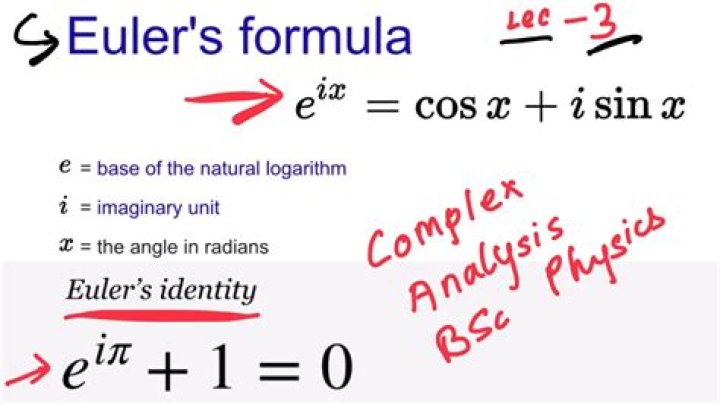
Is Euler's formula valid for complex arguments
I found this question here :
Evaluate $\cos(z)$, given that $z = i \log(2+\sqrt{3})$
It says that -$$e^{-iz} = \cos(z) - i \sin(z)$$isn't necessarily true because $$\sin z$$ is imaginary (for the particular value of z in the link). But, the proof of Euler's formula using Maclaurin series suggests that it should be valid for complex arguments too. What am I missing?
$\endgroup$ 12 Answers
$\begingroup$No, it doesn't say that $$e^{iz}=\cos(iz)-i\sin(iz)$$is not necessarily true! It is true. What it says in that other answer is that $\cos(iz)$ is not necessarily the real part of $e^{iz}$.
$\endgroup$ $\begingroup$You are missing nothing: for every complex number $z$, $e^{iz}=\cos z+i\sin z$.
$\endgroup$ 1