Is an ellipse a circle transformed by a simple formula?
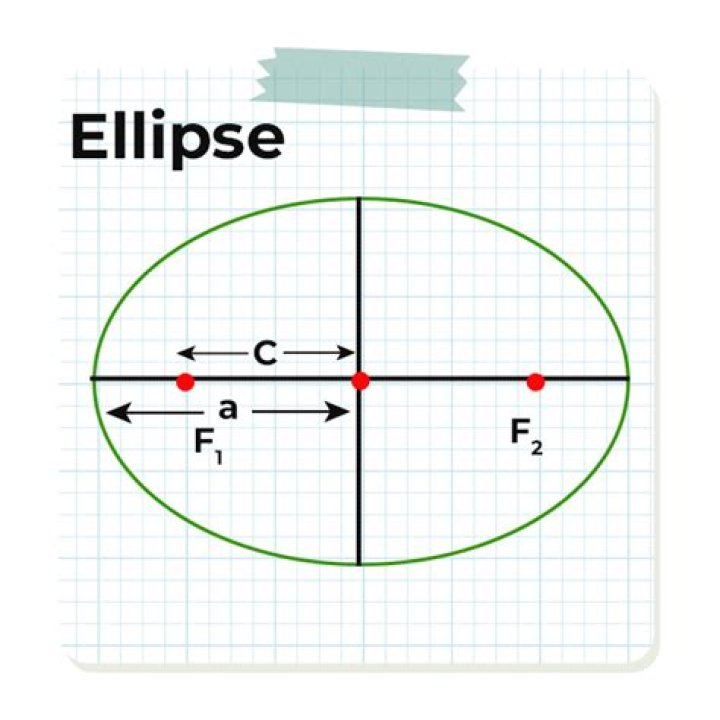
Does any ellipse $E$ have a circle $C$ such that you can obtain $E$ by transforming $C$ by a simple formula $F$? In details , both $E$ and $C$ have the same center and the axes of $E$ are the XY axes. And F moves $(x,y)$ to $( m*x , y)$ . Where m is a real number.
Thank you in advance.
$\endgroup$ 35 Answers
$\begingroup$I think you'll see it from $$ {\rm ellipse:\ \ }{x^2\over a^2}+{y^2\over b^2}=1. $$
$$ {\rm circle:\ \ } {x^2\over b^2}+{y^2\over b^2}=1. $$
$\endgroup$ 1 $\begingroup$Errata: For some reason, the answer I just submitted did not print the end of one sentence and the last paragraph. The entire sentence read: "In addition, if the semi-major axis is allowed to remain length 1, a=1 and 0
If you Google "circle transformation ellipse" you will see that Archimedes explored the transformation. Yet, even our new Commoon Core does not mention the close connections that conic sections have to other simple mathematical concepts.
$\endgroup$ $\begingroup$errata explained: I guess the website does not allow the use of the inequality symbols. The omitted end of the sentences read 0 is less than b is less than 1 which suggests that we let $b=sin(\theta)$. The foci are at $\pm cos(\theta)$, the directrices at $\pm sec(\theta)$ and the semi-focal width is $sin^{2}(\theta)$.
$\endgroup$ 1 $\begingroup$Since $\displaystyle \frac{x}{a}$ accomplishes a horizontal shear of magnitude $a$ and similarly for $\displaystyle \frac{y}{b}$ in the vertical direction, the unit circle $x^2 + y^2 =1$ after the shear will be the ellipse:
$$\left(\frac{x}{a}\right)^{2} + \left(\frac{y}{b}\right)^{2} = 1$$
In addition, if the semi-major axis is allowed to remain length $1$, $a=1$ and $0<b<1$. The latter suggests $b$ can be represented by $\sin(\theta)$. Explore and you will find that this unit ellipse has foci at $\pm \cos(\theta)$, directrices at $\pm \sec(\theta)$ and focal width $2\sin^{2}(\theta)$.
The connections between the unit circle, transformations and trigonometry are important for secondary students to understand. It is somewhat typical of textbooks to introduce a topic like conic sections with formulas of their own as if they were a different species of mathematical functions.
Even our new Common Core does not use the approach. If you Google "circle transformation ellipse" you will see that Archimedes noted this connection.
$\endgroup$ 1 $\begingroup$I'll do the scaling of the $y$-Axis. The scaling of the $x$-Axis is very similar and ShreevatsaR gave a really good hint in one of his comments above.
Every Point of a circle with center $M(0,0)$ and radius $a$ satisfies the following equation:\begin{equation} x^2 + y^2 = a^2 \end{equation}
Let $P(x_1,y_1)$ be an arbitrary point on this circle. We scale the coordinates of $P$ as follows$$x \mapsto x \qquad \text{and} \qquad y \mapsto \frac{b}{a}y.$$
So the mapped point $P'$ will have the coordinates $P'(x_1,\frac{b}{a}y_1)$. You can visualize it as follows (the example below is with $a=4$ and $b=2$):
Notice that the mapped point satisfies the following equation
$$x^2 + \frac{a^2y^2}{b^2}=a^2$$since$$x_1^2 + \frac{a^2b^2y_1^2}{b^2a^2}=a^2 \Leftrightarrow x_1^2 + y_1^2=a^2$$
and the latter is true, because $P$ is a point on the circle. Since the point $P$ was an arbitrary point on the circle, the above reasoning is true for every point $P$, on the circle and most importantly$$x^2 + \frac{a^2y^2}{b^2}=a^2$$is the equation of an ellipse, since$$x^2 + \frac{a^2y^2}{b^2}=a^2 \Leftrightarrow \frac{x^2}{a^2}+\frac{y^2}{b^2}=1.$$
$\endgroup$