Is a function that has a vertical tangent line a function?
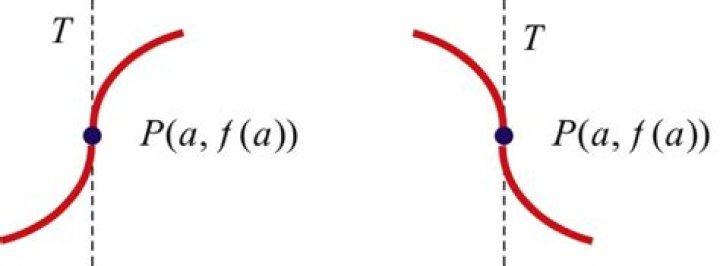
At, $a$, the function has a "infinite slope" or vertical tangent line. If the slope of the tangent line is considered to be the instantaneous rate of change, at that point, the function increases "straight up".
Since the function increases "straight up", the next point would be right above the previous point. Since a function can only have one value in the range per domain, and this function would at least two range values (the points right above each other) for the same domain value, wouldn't it violate the definition of a function?
Note that I understand that the function doesn't actually consist of discrete points, but is instead continuous. However, if the function is considered to consist of points infinitesimally close together, wouldn't the next "infinitesimally" far apart point be right above the previous point?
$\endgroup$ 126 Answers
$\begingroup$Having a vertical tangent line does not imply a graph does not represent a function. It may be easier to consider the example of a horizontal tangent line. For example: $$y=x^3 \implies y'= 3x^2$$
At $x=0$, we have a horizontal tangent line. Following the logic from the OP, the points just to the right and left of $x=0$ would have the same $y$ coordinate ($0$). However, we know from pre-calc that $y=x^3$ is a one-to-one function, which contradicts those other points having the same $y$ coordinate.
The same intuition applies to the vertical example.
Why is this? Essentially, it's because you're taking a limit. The slope of the tangent line could be thought of as the slope at one point, not between $2$ points...
Someone else may be able to give a more rigorous reasoning, but I hope this provides some intuition...
$\endgroup$ 2 $\begingroup$Minor nitpick: all lines are straight, so a better term for what you're looking at would be "vertical" tangent line.
Now, tangent lines only make sense for differentiable functions, so you shouldn't expect that tangent lines are going to tell you whether or not something is a function. What your example would show is that such a function is not differentiable at the point where you have the vertical tangent.
$\endgroup$ 2 $\begingroup$However, if the function is considered to consist of points infinitesimally close together, wouldn't the next "infinitesimally" far apart point be right above the previous point?
Nope. In the most reasonable formulation of infinitesimals for this sort of intuitive reasoning, it turns out that any point infinitesimally close to (but distinct from) $P$ still has $x$ different from (but infinitesimally close to) $a$.
As an aside, even if your claim were true: that when you change the problem to one with infinitesimals you would get two points on the curve with the same $x$ coordinate, you still haven't proven that $f$ is not a function: the condition that $f$ is a function is not expressed in terms of infinitesimals. You would need some additional argument to argue that the observation made in the changed problem really is telling us something about $f$.
$\endgroup$ $\begingroup$Yes.
A function can be a function irrespective of whether its tangents have finite slope with respect to the coordinate system being used.
Indeed, a function need not be differentiable to be a function.
A function need not even be continuous to be a function!
The only requirement that is put on the traditional notion of a function prescribed in single-variable calculus is the notion of independent variable uniqueness; that is, for a function $f : X \to Y$, and for $x \in X$, there is only a single element in $X \times Y$ that has $x$ as the first coordinate. (Think one-to-one, but backwards).
$\sqrt{x}$ is not differentiable at 0; clearly it's tangent line is the y-axis, but it is a function under the aforementioned definition.
$\endgroup$ 0 $\begingroup$Such a function is a function because it assigns an output to each input. It does not assign two or more outputs to any input.
If you deal with literal infinitesimals, and want to be logically rigorous, then I think the answer might depend on which of two or more systems you're working with. There's Robinson's nonstandard analysis and there's the later "smooth infinitesimal analysis". I'm not sure what happens with the latter. In Robinson's system it's still a function. Going from one point to another on the graph when the distance between them is infinitesimal, you go upward by an infinitesimal amount that is infinite by comparison to the horizontal movement. But the latter is still not exactly $0$, so you don't get two outputs for one input.
If you don't want to be logically rigorous, I might consider relaxing the definition of "function" and still saying "Yes, it's a function." The modern conventional definition of "function" I think might not really have been standard until less than a century ago, and just might not be sacred.
$\endgroup$ $\begingroup$A tangent at a point P only approximates a function in a small interval around P. Other than at the point P, there will always be a difference(no matter how small), between the function and the tangent.
$\endgroup$